Visit the Weil Vitamin Advisor Supplement Library and discover the high-quality vitamins and supplements that our personalized questionnaire recommends to customize your plan, shipped conveniently to you each month.
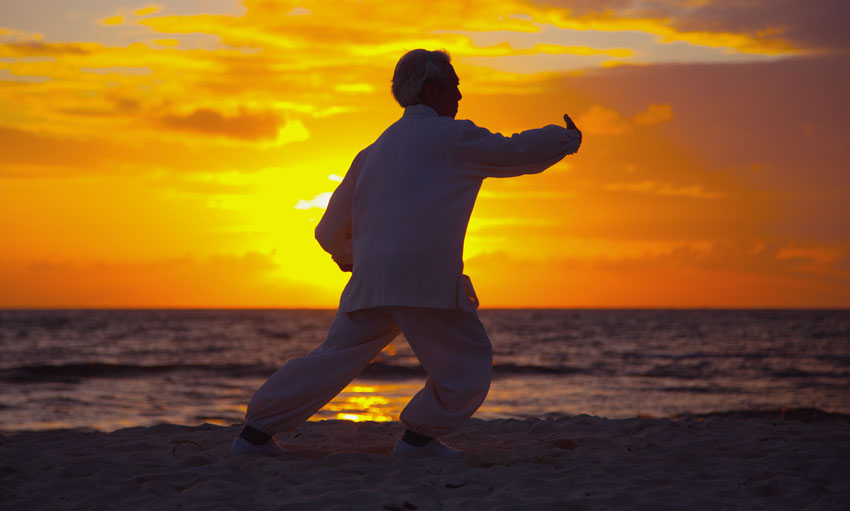
It is extremely difficult to bridge the gap between actually doing the tai chi form and improving your meditative-mindful state. On one hand, doing the form feels good and we definitely feel better afterwards. But how do we answer the questions from students, classmates, and ourselves such as:
What should I be thinking about when I do the form?
Does your mind race?
Are you concentrating on something?
I will admit to you dear reader that I have historically been at a loss for providing a concise response that was satisfying. But I found a really solid answer. I was reading on Mindfulness and forgot I was reading on Mindfulness because I read this:
To cultivate the healing power of mindfulness requires much more than mechanically following a recipe or a set of instructions. No real process of learning is like that. It is only when the mind is open and receptive that learning and seeing and change can occur. In practicing mindfulness you will have to bring your whole being to the process. You can’t just assume a meditative posture and hope that something will magically just happen, nor can you play a CD and think that the CD is going to “do something” for you. (p. 19*).
Doesn’t that sound like Tai Chi?
The leading researcher on Mindfulness, Jon Kabat-Zinn, speaks of major pillars of mindfulness that can be addressed simultaneously or individually to lead to a greater mental state. Through Wiseman‘s work we know that physical movement can produce desired emotional states. I will use this essay to interpret 5 of Zinn’s Pillars of Mindfulness in terms of doing the tai chi form. Let’s watch Jon Kabat-Zinn in these short explanations and then apply them to tai chi.
Mindfulness and Tai Chi
1. Non–judging
Mindfulness is: “the awareness that arises from paying attention on purpose in the present moment, non-judgmentally.” We spend a great deal of our waking hours judging and creating opinions on all of our actions and things that happen around us. We are often most severe with ourselves when we are learning something new or are trying to improve ourselves. Our job is not to try to turn this off but to witness it taking place. To see ourselves as separate from the judging process so that we can enjoy, experience, and see things how they really are. Read: do not judge your form while you are doing it. Enjoy the process and know that this is (currently) your best attempt.
2. Patience
Do you want to complete the tai chi form more than you want to perform it? The byproduct of rushing is that we are never mentally happy or present with what is actually going on. Patience; the belief that things unfold in their own way, allows us to enjoy the millions of minutes of the process and not only the single second of completion.
3. Beginner’s Mind
Beginner’s mind returns the excitement to our repetitive daily activities. Each time we return to do the form we are better than the last time simply due to our experience. How many of us concentrate on the few moves we can’t remember versus the many we do well? A beginner is open to endless possibilities and isn’t looking at the “task” of doing the form through a clouded, negative lens.
4· Trust
“Can we come to trust the natural wisdom of the body?” Do we take our breathing and heartbeat for granted until something bad happens? Tai Chi gives us the chance to listen to the breath, think about what we are looking at, etc. Bringing awareness to all of the body processes that naturally occur without our intervention increases our trust and can increase our confidence in situations that might not be 100% in our control (a.k.a. every situation).
5. Non-striving
Tai Chi is a rare opportunity where we can just let things be as they are. Tai Chi is a tremendous discipline to show us that we can be present AND be completing something, rather than ignoring our present moment and racing to some future goal. Kabat-Zinn shares that present-mindedness is tremendously healing and restorative.
“The attitude with which you undertake the practice of paying attention and being in the present is crucial. It is the soil in which you will be cultivating your ability to calm your mind and to relax your body, to concentrate and to see more clearly. If the attitudinal soil is depleted, that is, if your energy and commitment to practice are low, it will be hard to develop calmness and relaxation with any consistency. If the soil is really polluted, that is, if you are trying to force yourself to feel relaxed and demand of yourself that “something happen,” nothing will grow at all and you will quickly conclude that “meditation doesn’t work.”
*Full catastrophe living: using the wisdom of your body and mind to face stress, pain, and illness Jon Kabat-Zinn – Pub. by Dell Pub., a division of Bantam Doubleday Dell Pub. Group – 1991
Original article and pictures take taichibasics.com site
Tung Hu Ling (1917-1992) performs the Long Form of the classic Yang style of Tai Chi Chuan. Filmed in 1960 during one of many visits that Tung Hu Ling made to Bangkok, Thailand to teach Tai Chi Chuan.
Tung Hu Ling learned his Tai Chi from his father Tung Ying Chieh, who was a prominent disciple of the Yang Family’s 3rd generation master Yang Cheng Fu. Tung Hu Ling also had the wonderful opportunity to be personally tutored by Yang Cheng Fu in the Yang style of Tai Chi Chuan.
Below is a great book for the Tai Chi enthusiast to have in their library! This book gathers together the written and photographic records of the teachings of the Yang Family about their style of Tai Chi Chuan. Click on the image below to see more!
If you enjoyed this wonderful Tai Chi Video, please click on the “Like” button!
Please leave a comment and let us know what you thought!
Original article and pictures take taichivideos.org site
Chinese numbers (1-10, 100 & 1000) for Tai Chi and Qi Gong people
Qi Gong and Taijiquan is full of numbers. 8 brocades, 108 form movements, 3 treasures etc. Thus I want to show you the numbers from China!
Let’s start with the Chinese number 1-10; 100 and 1000. And I added some examples from my Taijiquan & Qi Gong Dictionary!
Chinese numbers 1-10; 100; 1000
1 一 yī Yi Lu (First Form in Chen style Taijiquan)
2 二 èr Er Lu (Second Form in Chen style Taijiquan)
3 三 sān San Bao (Three Treasures)
5 五 wǔ Wu Qin Xi (Five Animals Qi Gong)
6 六 liù Liu Zi Jue (Six Healing Sounds)
8 八 bā Qi Jing Ba Mai (Eight Extraordinary Meridians)
10 十 shí
100 百 bǎi Bai Hui (“Hundred Convergences”, acupoint Du Mai 20)
1000 千 qiān Qian Jin Zhui (Thousand Pound Sinking)
I know that the strangest thing about the Chineses language is the pronunciation. If you want to learn counting in Mandarin Chinese, have a look at this video and repeat what he says:
El Chi Kung o Qi Gong es una práctica corporal formada por suaves movimientos físicos, ejercicios respiratorios y concentración mental que surgió en China hace más de 4.000 años con el fin de fortalecer el organismo a nivel físico, mental y espiritual.
Chi es la energía vital de todos los elementos de la naturaleza, incluidos los seres humanos. Kung describe el trabajo constante y la habilidad adquirida tras un periodo de tiempo. Chi Kung, por tanto, se traduce por el cultivo y la práctica de la movilización consciente de la energía por el interior del cuerpo.
Integrado en la Medicina Tradicional China (MTC) por el emperador amarillo Huang Ti hace aproximadamente 2.000 años, el Chi Kung es un arte terapéutico que se utiliza para mantener la salud, aumentar la vitalidad y prevenir o curar enfermedades.
Taller de cuencos tibetanos
Curso de aromaterapia egipcia
UBK Ki Dojo Catalunya
Qué es el Chi Kung o Qi Gong
El Chi Kung o Qi Gong es una práctica corporal formada por suaves movimientos físicos, ejercicios respiratorios y concentración mental que surgió en China hace unos 4.000 años con el fin de fortalecer el organismo a nivel físico, mental y espiritual.
Chi es la energía vital de todos los elementos de la naturaleza, incluidos los seres humanos. Kung describe el trabajo constante y la habilidad adquirida tras un periodo de tiempo. Chi Kung, por tanto, se traduce por el cultivo y la práctica de la movilización consciente de la energía por el interior del cuerpo.
Integrado en la Medicina Tradicional China (MTC) por el emperador amarillo Huang Ti hace aproximadamente 2.000 años, el Chi Kung es un arte terapéutico que se utiliza para mantener la salud, aumentar la vitalidad y prevenir o curar enfermedades.
Uno debe respirar la esencia de la vida, regular su respiración para preservar su espíritu y mantener sus músculos relajados. Cuando la mente está quieta y vacía, el verdadero Qi estará bajo tu control. Si uno mantiene una mente centrada el peligro de enfermedad desaparecerá.
Huang Di Nei Jing o “Clásico de Medicina Interna”
El Chi Kung, que se basa en una observación minuciosa de las leyes de la naturaleza, está relacionado con la filosofía taoísta, el pensamiento budista y la concepción china del cuerpo humano.
Según estos principios filosóficos todos los fenómenos del universo se pueden clasificar según aspectos Yin y aspectos Yang. Son Yin (femenino, reposo, frío, interior, blando, débil, recibir,…); mientras que son Yang (masculino, movimiento, calor, exterior, duro, fuerte, dar,…).
La MTC considera que en el cuerpo humano hay un sistema energético formado por una red de meridianos por los que fluye el Chi. Según esta medicina la enfermedad es la manifestación de un estancamiento o interrupción de esta energía interna que no puede circular libremente por este circuito energético.
El objetivo de todas las terapias que conforman la MTC (acupuntura, masaje, dietética, fitoterapia y Chi Kung) consiste en retornar al organismo el estado de equilibrio energético Yin-Yang que se ha perturbado, ya que el estado de salud se caracteriza por el equilibrio dinámico de estas dos fuerzas duales.
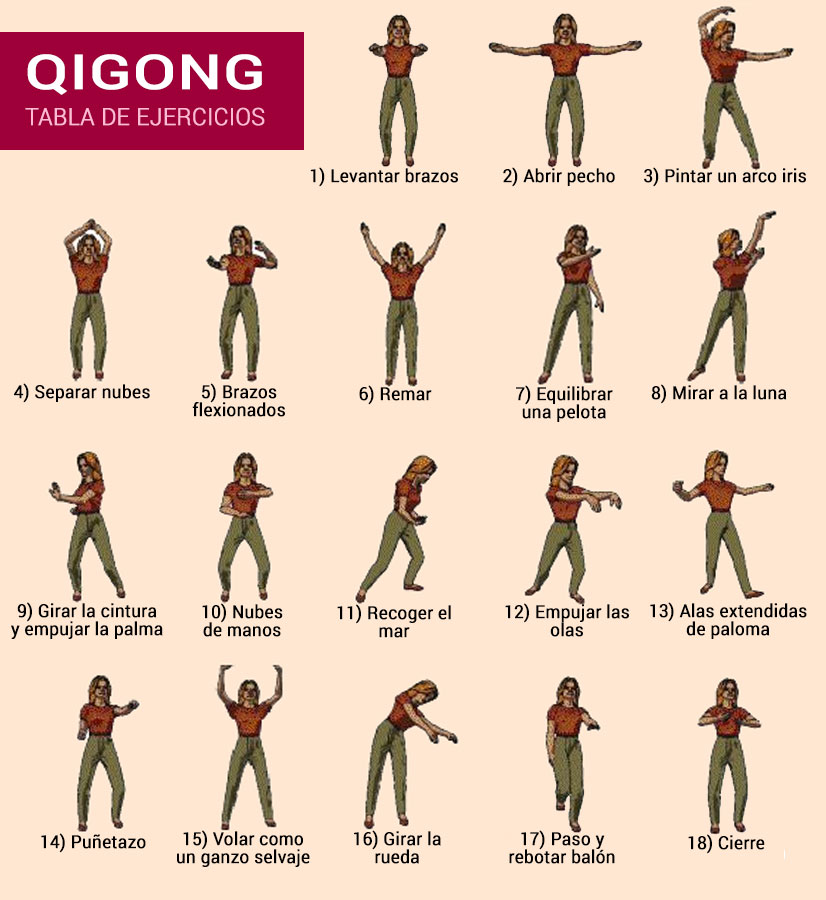
Tipo de ejercicios de Chi Kung
Existe gran diversidad de escuelas y técnicas de Chi Kung que se pueden clasificar según sus principios filosóficos (taoísta, budista o confucionista) o según sus aplicaciones (terapéutico, marcial o espiritual), pero en todas ellas su práctica está fundada en estos principios:
La actitud física y mental debe ser relajada (alejar pensamientos).
El movimiento debe ser suave, lento y grácil (sin rigideces, ni esfuerzo muscular).
La respiración debe ser abdominal, suave y sincronizada con el gesto (natural).
El pensamiento debe dirigir el Chi y la respiración al interior (visualizar cómo la energía recorre el cuerpo).
Las principales escuelas de Chi Kung combinan en sus prácticas los ejercicios estáticos (posiciones inmóviles) y los ejercicios dinámicos (movimiento corporal).
En el Chi Kung estático (Yin) la energía se acumula, nutre y proporciona fuerza interna: meditaciones, visualizaciones guiadas, fonación de sonidos,…
En el Chi Kung dinámico (Yang) el Chi fluye de forma homogénea por todo el cuerpo, se elimina la energía estancada y se produce un profundo equilibrio energético: ejercicios con mano vacía, con instrumentos como el palo o pelotas, automasaje Dao Yin,…
A pesar de toda su diversidad el objetivo común de todos los estilos de Chi Kung es generar la energía (Chi) que lo anima, liberar de obstrucciones su flujo y dirigirla a dónde sea necesario.
Beneficios del Chi Kung
Los beneficios de esta gimnasia terapéutica milenaria se pueden encontrar a nivel físico, mental, emocional y espiritual. En términos generales aumenta la energía vital, fortalece el cuerpo, calma la mente y tamiza las emociones.
Físicos: el masaje que ejerce el diafragma en cada respiración estimula la función de los órganos internos, activa la circulación sanguínea, aumenta la capacidad pulmonar y mejora el tránsito intestinal. El suave movimiento físico ejercita la musculatura, aumenta la flexibilidad, reduce el dolor articular y previene los problemas que provoca el sedentarismo en general.
Mentales: guiar la energía y la respiración por el interior del organismo disminuye los pensamientos negativos, aumenta la capacidad memorística y la concentración mental. La disminución de las preocupaciones facilita la regularización del sueño y aumenta la claridad mental.
Emocionales: la relajación física y mental regula la circulación por los meridianos que emergen de los órganos internos (corazón, hígado, bazo, pulmón y riñón) y las emociones que se relacionan con cada uno de ellos. Según la “teoría de los 5 elementos” en la que se basa la MTC: el corazón alberga la euforia, el hígado la ira, el bazo la preocupación, el pulmón la tristeza y el riñón el miedo.
Espirituales: su práctica es una vía para estar en armonía con la naturaleza, un camino para desarrollar las cualidades humanas y transformarse interiormente. El Chi Kung, como filosofía de vida, ayuda a mantener unos hábitos saludables y a mejorar la calidad de vida de todo aquel que lo practica.
El Chi Kung es una gimnasia oriental, que se adapta a cualquier edad y condición física, destinada a potenciar nuestro estado de salud: para sanarnos, revitalizarnos y desarrollarnos espiritualmente.
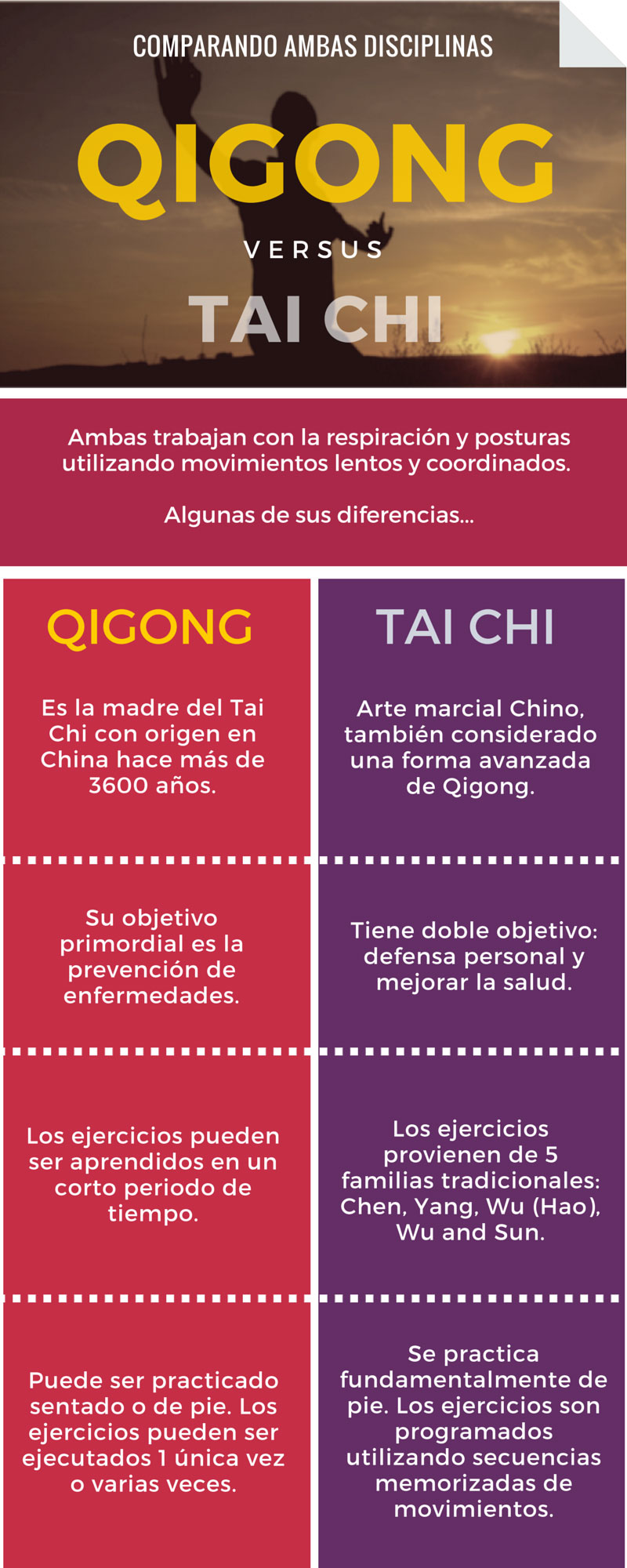
Diferencias entre el Qigong y el Tai Chi
Qigong y Tai Chi vienen de China y trabajan con la respiración y posturas, utilizando movimientos lentos y coordinados. Sin embargo, existen algunas pequeñas diferencias entre ellas. En esta tabla, reflejamos algunas de ellas de forma muy gráfica.
Vídeos sobre Qi Gong / Chi Kung
A continuación te dejamos algunos vídeos que te permitirán profundizar más sobre esta practica:
Qigong (Chikung) para combatir la ansiedad, estrés, angustia, depresión
Ejercicios de Qi Gong para el dolor de cuello
Original article and pictures take www.saludterapia.com site
Chi Gong and Tai Chi (Qi Gong) Energy Healing Exercises
Chi Gong and Tai Chi, (also spelled Qi Gong) are ancient Chinese healing energy exercises and techniques. These are simple movements combined with thought and intention to become healthy, increase energy, get rid of toxins, and relax the mind and body.
Shown in this video, host Bill Farr shows five simple techniques that will build chi, remove negative energy for the guided meditations on the website:
www.TheArtofUnity.com/chigong
full blog here:
Learn how to do Qi-Gong here -- www.theartofunity.com/tai-chi-for-beginners/
- Music - Arcadia- Kevin MacLeod (incompetech.com)
- Artwork of grounding chakras created by Katana Leigh at artlovelight.com.
Original article and pictures take s.ytimg.com site