Let's Come Together, Release Tension, Increase Balance and Feel Completely Relaxed with Tai Chi.
A graceful series of meditative movements that help maintain physical health, well-being and spiritual essence.
Some benefits may include relieving physical affects of stress and tension, reducing anxiety and depression, improves balance and stability, enhances mental capacity and concentration, promotes serenity, deep breathing and inner peace.
Join us as we practice 'Beginners' Tai Chi 24-form Yang Style, an ancient Chinese form that helps create a healthy balance of Yin-internal energy with Yang-external energy.
We recommend wearing comfortable clothing and bringing a bottle of water. If attending our outdoor classes, please dress according to weather conditions - protecting yourself from both hot or cold temperatures.
Classes are free; donations are graciously appreciated - suggested $3-$8 or simply tell your friends about us.
Anyone can learn Tai Chi - any age, all levels of fitness. If there are any medical condition, injuries, pregnancy, etc. please consult with your doctor prior to attending.
~ What People Are Saying ~
Great class! A great way to relax, get exercise, raise energy and enjoy the outdoors. I've never done this form before and I really love Angie's style - don't stress about getting every move perfect before moving on, you can practice part of the form at each class and refine each section as you continue your practice. Will definitely be back for more.
Like · Reply · 2 day ago · Mute
The experience was surreal. I had my expectations and they were exceeded. Angie is a wonderful, positive and excellent instructor. I am definitely looking forward to next week's class. It was a pleasure meeting the other attendees. Thank you Angie and I will see you next week.
Like · Reply · 1 day ago · Mute
Loved it! Definitely will continue learning Tai Chi. For my first visit Angie was patient, easy to understand and had a calmness that really helped me through my nervousness of trying something new. I love the low impact aspect of this.
Like · Reply · 2h ago · Mute
Excellent! I thought Angie was very clear with the instructions and went slow enough so we were able to keep up. I will be attending from now on.
Like · Reply · 1 day ago · Mute
It was a fun learning experience, the people participating were great; The instructor is awesome; can't wait until the next class!
Like · Reply · 1 day ago · Mute
Angie, as already said in person, u-r a true gift to Long Beach & this World! What a perfectly magnificent day spent here, calming ourselves thru this beautiful art form for body, soul & mind. Arrived slightly stressed from string of sometimes non-sensical days, chasing-our-own-tail activities, ...then suddenly leaving this ocean-view park super refreshed & uplifted! Infinity of blessings for bringing your light to/for us all! Til next one *cheerz & hugz* =)
"I'll never forget the first time I came across Tai Chi. It was at a 5-days silent retreat. I was walking in nature and noticed a man underneath this beautiful tree moving in a slow graceful manner. I didn’t know at the time what exactly he was doing, but I was fascinated with the graceful, almost meditative-like movements. I stopped and sat in awe, wondering what this was, but I couldn’t ask him because I was at a silent retreat :)
As soon as I got home I Googled, “graceful meditative movements”, and Tai Chi came up.
I searched for classes in my area and found a beginners group minutes away.
It only took attending 1 class to fall in love with the art. After a few months I then was invited to practice 3 days a week with a Master named Master Tâm at a Buddhist Temple in Long Beach Ca. There we practiced Tai Chi, Fan, Dao, Shaolin Cane and other like forms. Since then, I have become a Tai Chi Instructor, and my balance, focus and overall health has improved as a result of Tai Chi."
Private Lessons are available upon request. Single Lesson Cost: $65 for 1hr
Or
Package of 3 Lessons: $50 each ($150 to be paid in full on the day of first lesson)
To schedule a private lesson contact Angie Sierra at info@angiesierra.com
Qigong is one of the oldest exercises in Chinese history, dating back more than one thousand years.
There are numerous types of Qigong. Generally speaking, Qigong is a variety of breathing, gymnastic, and meditative exercises. In Chinese, Qi means several things; the most common meaning of Qi is air. Here, Qi means the life energy inside a person. This life energy comes from the combination of three things: the air breathed in through the lungs, essential Qi from the kidney, and the Qi absorbed from food and water through the digestive system. Qi circulates throughout the body, performing many functions to maintain good health. The stronger Qi you have, the healthier and stronger you are. The word Gong means a method of exercise that requires a great deal of time in which to become proficient.
Simply put, Qigong is a breathing exercise that requires regular practise, and is especially beneficial for health and mental relaxation. Qigong is an integrated part of Tai Chi.
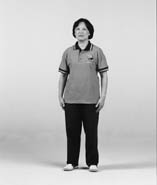
1. The Posture of Infinity – for posture awareness
According to ancient Chinese philosophy, the universe started from a vast void, the infinity. It is called wu-ji in Chinese. The main focus of this qigong exercise is for posture awareness.
Q1 Stand upright but relaxed, feet apart, knees relaxed, eyes looking forward, chin tucked in, shoulders relaxed.
Cleanse your mind and focus on the correct posture-upright without being tense.
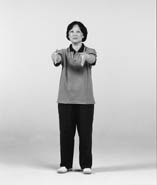
2. The Posture of Tai Chi – for Dan Tian awareness
From the vast void, the infinity, the universe developed into a state of Tai Chi, the supreme ultimate. It is like an immense ball comprised of two opposite and complementary halves, yin and yang. The main purpose of this is for Dan Tian awareness.
Dan Tian is the area approximately three fingerbreadths from the naval. It is the centre of Qi.
From Q1Posture awareness
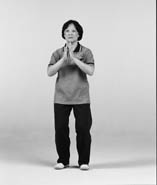
Q2A: Slowly bring your hands up, palms facing each other, breathing in.
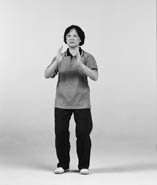
Q2B: Bring hands towards chest, bending knees slightly.
Focus and concentrate on the Dan Tian. When you get slightly tired, stretch your hands out to the previous posture, bring your hands down and slowly stand up. Dan Tian is an area three finger breadth below the belly button (Umbilicus) 3. The Posture of Opening and Closing – for breathing awareness
This is the working of yin and yang. Closing is yin and opening is yang. The purpose of this exercise is for breathing awareness. Breathing is the centre of all qigong exercise. The ancient Chinese believed breath is life and life is energy.
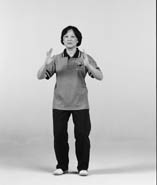
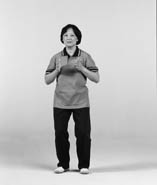
Q3A: From the previous posture, breathe in, open hands to shoulder width. If your knees feel tired, gently straighten them.
Q3B: Breathe out, pushing hands towards each other as close as possible without touching.
Gently bend your knees if you have straightened them in the previous move.
Continue opening and closing hands several times. Complete the exercise by stretching your hands forward, return to the previous position and straighten your knees.
Do this exercise three or less times to start with and then more as you are get stronger.
As you breathe in and out, imagine there is a gentle magnetic force between your palms. Pull against this resistance as you breathe in and push against it as you breathe out.
Keep your mouth closed but not tight, tongue lightly touching the upper palate
Using Abdomenal breathing method:
Imagine that as air is travelling through your nose, down the trachea (airway to the lungs), and filling the lungs and then the abdomen. Your abdomen is extended with the air, making it bulge gently outward. Then as you breathe out the abdomen contracts. You can mentally picture the air expelling from the abdomen, lungs, trachea and finally through your nose. (Physically, air does not enter your abdomen. This is a method using guided imagery to help utilise your diaphragm to open up more air space in your lungs.)
Using the reverse abdominal breathing method
This is for Qi awareness. It helps to circulate and cultivate your life energy.
Using the same imagery let air go through to the abdomen, except when breathing in the upper part of abdomen (where the stomach is) expands, and lower abdomen contracts. When breathing out (which is often faster when delivering force) the upper abdomen flattens and the lower abdomen extending outward. This is a more advanced method often adapted by Chen stylists. This method allows the Qi to sink to the Dan tian quickly and powerfully when delivering force which is more prevalent in Chen style. Chen style is not a suitable style to start with by people with arthritis … might be later when you are stronger.
4. The Posture of Raising and Lowering – for Qi awareness
Q2A : Slowly bring your hands up, breathing in.
Q4B:Bring your hands up along your chest and breath in.
Continue moving in the loop, standing up as you breathe in and bending down as you breathe out. Finish off after doing the exercise three times.
When you breathe in, visualise your Qi moving up to the middle of your chest. When you breathe out visualise your Qi moving down to the Dan Tian. It doesn’t matter if you don’t understand what Qi is. Simply think about this area as you breathe in and out. As your Tai Chi improves, you will be able to understand and feel the Qi. While the sensation of Qi is different to different people, for most, it feels like a warm and slightly heavy sensation.
Original article and pictures take taichi-4d7hcyno75y7zbms.netdna-ssl.com site
Forms - Yang Style Tai Chi Chuan • Tai Chi Sword and Saber
Classes - Private Lessons • Group Classes • Clinics • Seminars Women's Self Defense Seminars • Law Enforcement Seminars
We will post martial arts related articles and links to articles/videos on this page. If you have an article or link that you wish us to review for posting, please contact us.
We are not responsible for the content of articles/videos that are not generated by us. We will do our best to post truthful and verifiable material.
Here's a great film company, with some very well done, interesting and inspirational videos.
Lapel Grab Defense Application
Do you see any Taijiquan movements in this technique?
Two Interesting Tai Chi Movie Segments
The Shadow Boxer - The Tai Chi Way
The Tai Chi Master - Zhang Sanfeng Discovers Tai Chi
Applications by Yang Zhenduo & Yang Jun - Fair Lady Works Shuttle
Tung Ying Chieh - A student of Yang Cheng-Fu. You will notice it is a bit different from Fu Zhongwen's form (also a student of Cheng-Fu) or Yang Zhenduo's Yang family form. However, you can definitely also see many similarities in all of them. This is an example of how styles can vary, yet be derived from the same source. Time and an individual's focus and understanding of the form can have a definite impact on the development of an individual style. Even though it is often labeled "Tung Style" is still considered a traditional Yang Style. Additional forms were also introduced in Tung Style, such as the Tung Fast Form, etc.
Tung Style Tai Chi Performance
Seminar with 6th Generation Yang Family Tai Chi Chuan Master, Yang Jun
by Laoshi David West
I was recently invited by one of my past instructors (Laoshi Michael Coulon) to attend a two day seminar with Master Yang Jun.
At first I was hesitant, due to time constraints, etc, however after not too much contemplation, I made the decision to attend.
I knew from my former studies that the Yang Zhen Duo form, which Master Yang Jun's grandfather (Yang Zhen Duo) taught him, was somewhat different (mainly in the transitions) from the form that I normally practice (closer to Fu Zhongwen's form).
The seminar was covering the 3rd section of the Yang Family Long Form. I thought that by taking the seminar, I might just pick up a few little extras about the movements and be able to apply the teachings in some way to my existing form. Much to my surprise, I cannot believe how much more information I gleaned out of this seminar.
The first thing I will mention is the historic and theoretic detail that was presented by Master Yang was refreshing. Even with his self professed difficulty in the English language (which I thought was very good), it was great to see his concern for traditional Yang Style Tai Chi Chuan literature and understanding. Many of the things he mentioned matched my thoughts and what I have learned exactly. Sometimes you think all of the reading and studying we do is only for westerners... however through his speaking, he did confirm that most of the information we are getting is what is what was meant to be transmitted. Master Yang Jun further confirmed and demonstrated Master Yang Cheng Fu's policy of spreading true Yang Style Tai Chi Chuan, without withholding secrets.
Second, I would like to say that the transitions and postures taught by Master Yang Jun are very detailed and specific. Even though the transitions are in some ways slightly different than the way I have learned the movements, it brought to my attention that I need to pay more attention, and be more precise during the transitions, regardless of which method I use. I also picked up some ideas and details on the completed postures.
The third thing I would like to comment on is the application of Tai Chi Chuan principles within Master Yang Jun's form. Prior to this seminar, I had only seen videos of Master Yang Jun. During the seminar he presented all of the principles of alignment, stretching, bowing, sinking, full body movement, etc. that any Tai Chi Chuan practitioner would hold near and dear. It was quite pleasing to see that the principles we use are still taught by the Yang Family.
Lastly, I would like to comment on the effectiveness of the seminar in general. Most seminars I have attended, I have picked up a only a few things here and there. I usually only retain about 10-30 percent of any seminar. After this seminar with Master Yang Jun, I would say that I have retained about 80-90 percent of what he taught. I can now apply much of the teaching to enhance the quality of my form.
I highly recommend attending these seminars presented by the International Yang Style Tai Chi Chuan Association, regardless of how different you might think someone teaches from your method of practice. It was truly an honor to meet and study with Master Yang Jun.
Yang Shou Zhong, son of Yang Cheng Fu
Tai Chi - A Martial Art - Many think that Tai Chi is just a way to relax and get magically healthy... however the relaxation and health that you achieve from practicing Tai Chi Chuan is best realized when the martial arts intent is maintained while learning the art. Here is another article from the web, that is pretty descriptive of this concept.
Combat Yang Tai Chi Chuan - An interesting article by Peter Lim Tian Tek, with many good points on Yang Style Tai Chi Chuan as a supreme martial art. The name Tai Chi Chuan stands for Supreme Ultimate Fist/Boxing. It could also be translated as Grand Ultimate Kung Fu. Many proponents of external martial arts have adopted the softer "cotton fist" concepts of Tai Chi Chuan into their systems due to the superior movement and skills that are developed. We do not need to be fighters to practice Taiji, however we must train with the martial skills intended to truly learn the art of Tai Chi Chuan.
Tui Shou (Push Hands) is one of Tai Chi Chuan's way of working applications and using the energies cultivated in the learning of the internal kung fu (taiji) form. This practice is something that develops over years. I believe it is why the best of the best in displaying this portion of the art are usually very old. Tui Shou must take place effortlessly. Do not use external force. Take a look at these masters applying their skills in the art of Tai Chi Chuan Tui Show.
Developing a Warm-up & Stretching Routine
Classical Tai Chi Internal Discipline - Steven Hwa
Another Interesting Shaolin Kung-Fu Documentary
Wisdom and the Martial Arts - An article by David West
Code of Personal Improvement - Martial Arts have long been associated with wisdom and personal conduct codes. This is a code that we have developed from many sources that have stood the test of time. It should be reviewed from time to time to reflect on the areas in which you can develop and apply. Nobody will be perfect, however we should continue to strive towards improving these attributes.
Our Code - Develop Strength of Mind, Body & Spirit
Martial Art's Animals - Many martial arts have techniques and concepts based upon the observation of animal movement as well as their characteristics. Some styles also incorporate insects as part of their animal studies. Even Tai Chi Chuan (Tai Chi) has many movements that are animal based techniques.
Here are some links to various sites, etc. with information on the subject. These are for reference only, and should be viewed with discernment.
An interesting page with some useful Yang Cheng-Fu Style information. View photos of Yang Cheng-Fu in the Tai Chi Chuan Form Postures.
A brief view at an early filming of the five animal form we teach.
Tai Chi is not well known as a martial art, but rather a slow movement for health purposes. While Tai Chi (Tai Chi Chuan) is healthy to practice, it is actually one of the most effective styles of Kung Fu know to man... however, the martial applications are somewhat disguised by Tai Chi Chuan's slow and graceful practice methods. Here are some videos that attempt to represent martial applications of Tai Chi.
An interesting documentary on Shaolin Kung Fu and the Shaolin Temple.
Here are some videos by Tai Chi Chuan Masters closest to the style we teach. Our Tai Chi Chuan is closest to Fu Zongwen's form with some influences from Yang Zhenduo's form... also with additional principles as taught by Laoshi Ron Mathews... emphasizing strong postures, sound movement and martial applications. Our students should view the videos only as additional reference. Students should not attempt to learn postures and movements from these videos. Remember that your form will be most graceful if each movement and posture contains strength, intention and correct alignment.
Group Classes Located in Downtown Nashua, NH.
Close to these New Hampshire locations: Amherst, Nashua, Merrimack, Hollis, Milford, Mt. Vernon and many more NH towns. Also not far from many Massachusetts towns.
Original article and pictures take www.yangstyle.com site
Each year, more than one-third of people age 65 or older fall. Falls and fall-related injuries, such as hip fracture, can have a serious impact on an older person's life. If you fall, it could limit your activities or make it impossible to live independently.
Maintaing your balance is crucial. Balance exercises, along with certain strength exercises, can help prevent falls by improving your ability to control and maintain your body's position, whether you are moving or still.
Some exercises can make you less likely to fall. They do this because they:
Make your muscles stronger
Improve your balance
Make your muscles more flexible
Increase how long you can be active
When you exercise, always make sure you breathe slowly and easily. Do not hold your breath.
Beneficial Balance Exercises
You can do some balance exercises during everyday activities.
While waiting in line at the store, try balancing on 1 foot.
Try sitting down and standing up without using your hands.
Toe Stand - What it does: Makes your calves and ankle muscles stronger.
Hold on to a solid support for balance, like the back of a chair.
Stand with your back straight and slightly bend both knees.
Push uponto your tiptoes as high as possible.
Slowly lower your heels to the floor.
Repeat 10 - 15 times.
Knee Curl - What it does: Makes your buttock and lower back muscles stronger.
Hold on to a solid support for balance, like the back of a chair.
Stand with your back straight, feet shoulder width apart, and slightly bend both knees.
Lift 1 leg straight back behind you, then bend your knee and bring your heel toward your buttock.
Slowly lower your leg back to a standing position.
Repeat 10 - 15 times with each leg.
Leg Extension - What it does: Makes your thigh muscles stronger and may decrease knee pain.
Sit in a straight-back chair with your feet on the floor.
Straighten 1 leg out in front of you as much as possible.
Slowly lower your leg back down.
Repeat 10 - 15 times with each leg.
Stretching the Back of Your Leg - What it does: Makes it easier for you to move around.
Sit in a straight-back chair.
Put 1 foot on a low stool in front of you.
Straighten your leg that is on the stool and reach your hand toward this foot.
Hold for 10 - 20 seconds, then sit back up.
Repeat 5 times with each leg.
Other Activities
Walking is a great way to improve your strength, balance, and endurance.
Use a walking stick or walker as needed for support.
As you get stronger, try walking on uneven ground, such as sand or gravel.
Benefits of Tai Chi for Preventing Senior Falls
The benefits of Tai Chi for seniors are incredible. If you are looking for a low-impact, relaxing form of exercise that only requires about 20 minutes a day and rewards your efforts, Tai Chi is for you.
Tai Chi is an internal Chinese martial art in the sense that it focuses on mental and spiritual aspects integrated into movement. This meditative form of exercise consists of a series of 19 movements and one pose. You may have seen groups of people demonstrating its slow-moving circular forms in public parks. Many seniors and senior care facilities have been enjoying this style of workout and conditioning for more than 20 years.
Added Benefits of Tai Chi
Relieves physical affects of stress
Promotes deep breathing
Reduces bone loss in menopausal women
Improves lower body and leg strength
Helps with arthritis pain
Reduces blood pressure
Requires mind and body integration through mental imagery
Accumulates energy by releasing endorphins rather than depleting it
Enhances mental capacity and concentration
Improves balance and stability by strengthening ankles and knees
Promotes faster recovery from strokes and heart attacks
Improves conditions of Alzheimer's, Multiple Sclerosis, and Parkinson's
When to Call the Doctor
If you have pain, dizziness, or problems breathing during or after an exercise, stop and talk with your physical therapist, nurse or doctor.
Related Articles:
Original article and pictures take www.elderoptionsoftexas.com site
As you grow older you understand that your body is not the same as it used to be. It is quite a bit more susceptible to all sorts of back pain. In reality, neck and back pain can affect anyone. The following post will offer some excellent pointers on exactly what to do about easing your back pain.
Regular Workout
A regular program of workout can be crucial in preventing or dealing with back discomfort. Like the rest of the muscles in your body, your back muscles grow weak if they are not worked out. Many individuals mistakenly assume that you must not exercise when you have back discomfort.
Use Ergonomic Chair
Consider switching your most frequently utilized chair into an ergonomic chair. There are numerous ergonomically created chairs nowadays that are made just for those that are sitting at a desk or staying up all day. These chairs promote better positioning within the chair, and hence lesser stress on your back.
Identify Your Back Pain, Severe or Chronic ?
It is important to know and comprehend whether your neck and back pain is severe or chronic. Chronic pain in the back lasts for more than three months and is a constant pain in the back generally from the outcome of an injury or health problem. Intense pain in the back can likewise originate from an injury and for other reasons and normally begins quick and lasts for just a short amount of time.
Don’t Smoke
Amongst all of its other health threats, smoking cigarettes can decrease the blood supply to the vertebrae that make up your spinal column. This sort of disk damage doesn’t cause passing back pain but irreversible injury.
Keep Proper Posture While Walking or Sitting
Among the most common reasons for persistent back pain is bad posture. Slouching can cause pain, muscle tension and reduced mobility. When you walk, keep your shoulders back and attempt to keep your back straight. When sitting at your computer system or desk, put a pillow or rolled up towel behind your lower back for assistance and keep your shoulders back.
Surgery As Last Resort
Surgery is expensive and can lead to additional issues consisting of infection and even worse back discomfort. When you consider surgery for your back, make sure that you have actually done whatever you might have done in advance.
Flexing Down After Exercising
Prevent flexing down rapidly without heating up. Tense muscles contribute to clipped ligaments and severe lower neck and back pain. When you have to flex down, do it in a sluggish motion, instead of quickly, to avoid harming your back. Another thing to keep in mind is to keep your back warm in winter, in order to prevent the tensing of muscles.
It’s All About Taking Good Care of Your Muscle
So as you can see, you do not have to feel like you are getting older due to the fact that of the pain in the back that you are feeling. These suggestions will assist you live a better freer life without the back pain that has actually been slowing you down. So do not squander a minute and put this guidance to utilize.
It is quite a bit more vulnerable to all sorts of back discomfort In reality, back pain can affect anybody. Persistent back pain lasts for more than three months and is a constant back pain normally from the outcome of an injury or illness. When you walk, keep your shoulders back and try to keep your back straight. When sitting at your computer system or desk, rolled or put a pillow up towel behind your lower back for support and keep your shoulders back.
Tense muscles contribute to clipped ligaments and severe lower back discomfort.
Visit the Weil Vitamin Advisor Supplement Library and discover the high-quality vitamins and supplements that our personalized questionnaire recommends to customize your plan, shipped conveniently to you each month.
It is extremely difficult to bridge the gap between actually doing the tai chi form and improving your meditative-mindful state. On one hand, doing the form feels good and we definitely feel better afterwards. But how do we answer the questions from students, classmates, and ourselves such as:
What should I be thinking about when I do the form?
Does your mind race?
Are you concentrating on something?
I will admit to you dear reader that I have historically been at a loss for providing a concise response that was satisfying. But I found a really solid answer. I was reading on Mindfulness and forgot I was reading on Mindfulness because I read this:
To cultivate the healing power of mindfulness requires much more than mechanically following a recipe or a set of instructions. No real process of learning is like that. It is only when the mind is open and receptive that learning and seeing and change can occur. In practicing mindfulness you will have to bring your whole being to the process. You can’t just assume a meditative posture and hope that something will magically just happen, nor can you play a CD and think that the CD is going to “do something” for you. (p. 19*).
Doesn’t that sound like Tai Chi?
The leading researcher on Mindfulness, Jon Kabat-Zinn, speaks of major pillars of mindfulness that can be addressed simultaneously or individually to lead to a greater mental state. Through Wiseman‘s work we know that physical movement can produce desired emotional states. I will use this essay to interpret 5 of Zinn’s Pillars of Mindfulness in terms of doing the tai chi form. Let’s watch Jon Kabat-Zinn in these short explanations and then apply them to tai chi.
Mindfulness and Tai Chi
1. Non–judging
Mindfulness is: “the awareness that arises from paying attention on purpose in the present moment, non-judgmentally.” We spend a great deal of our waking hours judging and creating opinions on all of our actions and things that happen around us. We are often most severe with ourselves when we are learning something new or are trying to improve ourselves. Our job is not to try to turn this off but to witness it taking place. To see ourselves as separate from the judging process so that we can enjoy, experience, and see things how they really are. Read: do not judge your form while you are doing it. Enjoy the process and know that this is (currently) your best attempt.
2. Patience
Do you want to complete the tai chi form more than you want to perform it? The byproduct of rushing is that we are never mentally happy or present with what is actually going on. Patience; the belief that things unfold in their own way, allows us to enjoy the millions of minutes of the process and not only the single second of completion.
3. Beginner’s Mind
Beginner’s mind returns the excitement to our repetitive daily activities. Each time we return to do the form we are better than the last time simply due to our experience. How many of us concentrate on the few moves we can’t remember versus the many we do well? A beginner is open to endless possibilities and isn’t looking at the “task” of doing the form through a clouded, negative lens.
4· Trust
“Can we come to trust the natural wisdom of the body?” Do we take our breathing and heartbeat for granted until something bad happens? Tai Chi gives us the chance to listen to the breath, think about what we are looking at, etc. Bringing awareness to all of the body processes that naturally occur without our intervention increases our trust and can increase our confidence in situations that might not be 100% in our control (a.k.a. every situation).
5. Non-striving
Tai Chi is a rare opportunity where we can just let things be as they are. Tai Chi is a tremendous discipline to show us that we can be present AND be completing something, rather than ignoring our present moment and racing to some future goal. Kabat-Zinn shares that present-mindedness is tremendously healing and restorative.
“The attitude with which you undertake the practice of paying attention and being in the present is crucial. It is the soil in which you will be cultivating your ability to calm your mind and to relax your body, to concentrate and to see more clearly. If the attitudinal soil is depleted, that is, if your energy and commitment to practice are low, it will be hard to develop calmness and relaxation with any consistency. If the soil is really polluted, that is, if you are trying to force yourself to feel relaxed and demand of yourself that “something happen,” nothing will grow at all and you will quickly conclude that “meditation doesn’t work.”
*Full catastrophe living: using the wisdom of your body and mind to face stress, pain, and illness Jon Kabat-Zinn – Pub. by Dell Pub., a division of Bantam Doubleday Dell Pub. Group – 1991
Original article and pictures take taichibasics.com site