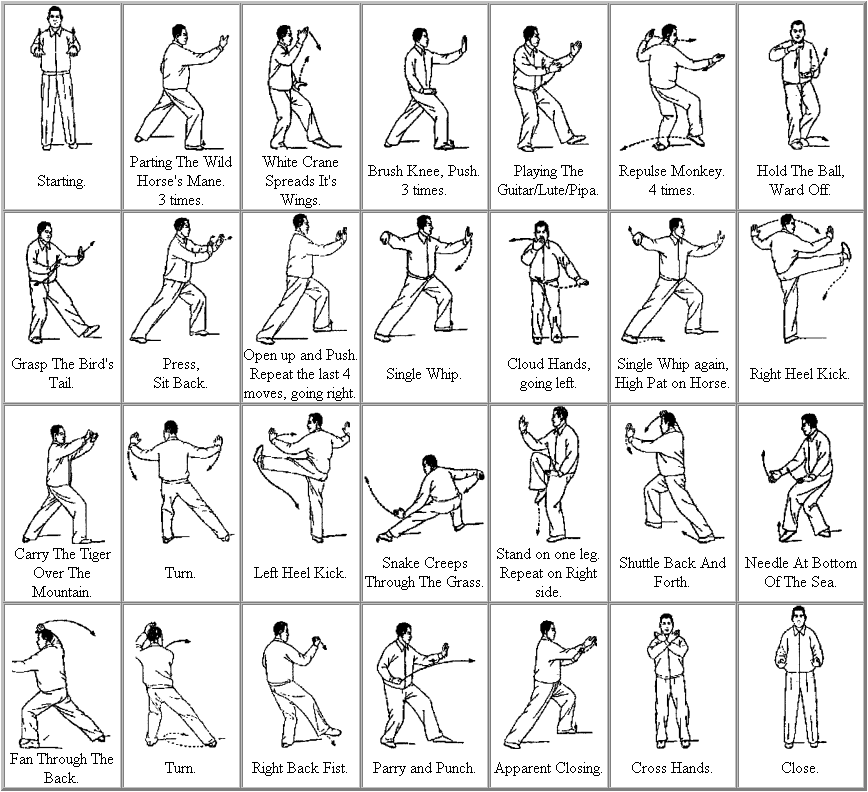
It's the first day of my new Series, "100 Days of Tai Chi." Learn the traditional Yang Family 103 movement Long Form. Every day for the next 100 days I'm posting a new lesson. Step by step you can learn this Tai Chi routine at home. In today's video, I'll teach you the first two moves: Commencement, and Ward-off left.
Want to study with me LIVE? I'm working every day in my online studio. To book a free guidance session, visit TaijiFit.net/guidance. It's never too late to make a difference (look at me - I'm 60!) Any challenge can be overcome when we face it together!
Other programs at TaijiFit Academy begin with the FREE membership at TaijiFit.net/free. See you soon!
Le tai-chi, avec plusieurs autres techniques, fait partie des Approches corps-esprit. Une fiche complète présente les principes sur lesquels se fondent ces approches, ainsi que leurs principales applications potentielles.
Réduire le risque de chute et améliorer l’équilibre des personnes âgées. Aider au contrôle de l’hypertension et réduire les risques de maladies cardiovasculaires.
Améliorer les capacités fonctionnelles des femmes ayant surmonté un cancer du sein. Améliorer le sommeil des personnes âgées. Améliorer la capacité aérobique. Promouvoir la santé mentale. Améliorer la capacité pulmonaire. Réduire certains symptômes de l’arthrite rhumatoïde. Soulager l’arthrose du genou.
Aider au contrôle de l’hypertension des personnes âgées. Réduire l’ostéoporose. Réduire les symptômes de la fibromyalgie. Contribuer à contrôler le diabète. Aider à diminuer les symptômes de la maladie de Parkinson. Aider à la prise en charge du poids des femmes obèses.
Dérivé des arts martiaux, le tai-chi est une discipline corporelle d’origine chinoise comportant un ensemble de mouvements continus et circulaires exécutés avec lenteur et précision dans un ordre préétabli. Il met aussi l’accent sur la maîtrise de la respiration. La pratique vise entre autres à améliorer la souplesse, à renforcer le système musculosquelettique et à maintenir une bonne santé physique, mentale et spirituelle. Selon ses adeptes, grâce à son côté méditatif et à l’extrême précision des gestes, le tai-chi permettrait d’apaiser le mental et d’améliorer la concentration, la vivacité d’esprit et la mémoire. Il favoriserait aussi une meilleure prise de conscience de soi et de son environnement et contribuerait à harmoniser le Qi.
Pour bien saisir ce qu’est le tai-chi, il faut savoir qu’il forme, avec le Qi Gong, l’une des 5 branches de la Médecine traditionnelle chinoise (MTC) : celle des exercices énergétiques. Les 4 autres branches sont l’acupuncture, la diététique chinoise, la pharmacopée chinoise (herbes médicinales) et le massage Tui Na. Il faut donc aborder le tai-chi dans le contexte plus large de la MTC qui est présentée dans la fiche du même nom.
Le tai-chi est aujourd’hui considéré comme une « gymnastique énergétique globale ». Notons que le Qi Gong se distingue du tai-chi par ses mouvements plus courts et isolés qui peuvent parfois être exécutés en position couchée, tandis que le tai-chi est essentiellement pratiqué en posture verticale.
Une technique de combat secrète
Au cours des siècles, la société chinoise, régulièrement menacée par des guerres frontalières et intérieures, a développé une solide tradition martiale. Le tai-chi était au départ une technique de combat transmise oralement, de maître à élève, dans le plus grand secret au sein de familles de paysans. Son origine demeure difficile à déterminer, histoire et mythe étant inextricablement liés. Toutefois, plusieurs auteurs accordent à Zhang Sanfeng, un moine chinois ayant vécu au XVIe siècle (ou peut-être au XIIe siècle), d’avoir créé les 13 postures de base du tai-chi. On dit que Sanfeng se serait inspiré d’un combat entre un oiseau et un serpent pour concevoir les enchaînements. Le serpent aurait triomphé grâce à sa lenteur, à sa souplesse et à ses mouvements arrondis qui donnèrent peu d’emprise à son adversaire.
De technique de combat à gymnastique
Au fil des années, la technique du tai-chi s’est beaucoup simplifiée et adoucie, même si certains maîtres ont continué à transmettre les notions martiales traditionnelles (par exemple, la connaissance des points vitaux mortels). En 1976, lors de la réouverture des universités en Chine, on a assisté à un changement majeur. Le tai-chi est alors devenu une discipline accessible à la masse et enseignée dans les programmes d’éducation physique universitaires. Il a perdu en grande partie sa composante énergétique (travail du Qi). Pour sa part, le Qi Gong s’est intégré aux programmes de médecine. Les 2 disciplines ont cependant conservé une visée thérapeutique. De nos jours, des millions de Chinois pratiquent quotidiennement le tai-chi, en particulier les aînés, mais plusieurs s’y adonnent pour des raisons de développement intérieur, qui vont bien au-delà de l’entraînement physique. Il a été introduit en Amérique du Nord au début des années 1970.
Ralentir avant tout
Le tai-chi ne s’apprend pas en deux temps, trois mouvements... Il nécessite persévérance, rigueur et assiduité si l’on veut bénéficier de ses effets positifs. On recommande de s’exercer de 15 à 20 minutes, 2 fois par jour. Selon Francine Tellier1, une maître de tai-chi formée en Chine, la difficulté initiale pour les débutants est d’apprendre à ralentir. En effet, c’est l’extrême lenteur d’exécution qui permet de déceler les blocages et de sentir le courant énergétique. De plus, la prise de conscience du transfert, lent et précis, du poids du corps d’une jambe à l’autre et le jeu d’alternance des bras et des jambes concrétisent parfaitement la pensée chinoise basée sur l’équilibre dynamique des forces du Yin et du Yang.
Vlady Stévanovitch2, qui a élaboré sa propre méthode, affirme que c’est en observant la position des mains que l’on peut déterminer la qualité des mouvements du pratiquant. Durant les enchaînements, ce sont les mains qui guident les déplacements et qui captent et dirigent l’énergie afin que le corps trouve son appui dans le Tan Tien, le centre de gravité situé un peu en bas du nombril. L’essence du tai-chi réside dans la recherche de l’équilibre des deux pôles de l’énergie, le Yin, issu de la terre, et le Yang, issu du ciel.
Tai Ji, Tai Chi, Taichi, Quan, Chuan?
En 1958, lors de l’instauration du pinyin (le système de transcription phonétique de la langue chinoise), c’est la graphie Tai Ji Quan qui a été adoptée. Depuis, plusieurs autres ont été approuvées, par exemple tai-chi, taï chi, taichi et tai-chi-chuan.
L’expression Tai Ji Quan se compose de 3 idéogrammes, dont les deux premiers signifient littéralement « faîte suprême » et incluent à la fois des notions d’équilibre dynamique et de but à atteindre. Le troisième caractère, Quan, signifie « poing » ou « combat à mains nues », et incorpore la dimension des arts martiaux. Les 3 caractères peuvent donc se traduire par combat suprême avec un adversaire ou avec soi-même.
Original article and pictures take www.passeportsante.net site
Lancaster School of Tai Chi Chuan Welcome to our website!
Tai Chi Chuan is an ancient Chinese discipline that strives to combine the mind and the body through martial training, meditation and exercise.
When practiced regularly, Tai Chi provides extraordinary health benefits, improves balance, flexibility and strength while calming the spirit and reducing stress.
We hold local Tai Chi classes which are suitable for all levels of physical ability and experience. Please see the instructor information page for details of which class would be most suitable for you.
Much of Tai Chi is practiced in a slow, mindful way which provides a good workout without inflicting high impact stress on the body. This makes Tai Chi accessible to everyone, including those recovering from injury or suffering from joint conditions.
As well as our regular classes and because of the great benefits of Tai Chi practice, the Lancaster School of Tai Chi Chuan can also arrange specialist sessions for any interested groups.
If you would prefer a private class on a one-to-one basis this can also be arranged.
Original article and pictures take ssl.gstatic.com site
Just 12 Weeks of Tai Chi For Better Health Tai Chi Chuan
The Importance of Exercise in Older Age
With increasing life expectancies, it is becoming more important for people to take up some form of exercise to ensure that they can remain active in their retirement.
Tai Chi Chuan is a gentle but energetic form of exercise, which not only improves physical health and fitness, as proved in this research, but has also been shown to improve mental health and well-being.
What Is Tai Chi?
Tai Chi Chuan is a “soft” style of kung-fu. Its roots are very much in martial arts and many people still train tai chi as a form of self defence. The applications of the movements are very effective in combat situations, although a good grounding in “hard” styles of kung-fu (or other styles) is really required.
Many people today learn tai chi as a form of gentle exercise. There is some debate over how effective this is and how it compares to other ways of staying fit and strong. Yang Ma Lee, the grand daughter of Yang Chen-Fu who helped to popularize the Yang system of Tai Chi (Yang Chen Fu was the grandson of Yang Lu-chan, the founder of they Yang family style), has said that without learning the martial part of tai chi you lose out on most of the health benefits.
Where to Learn Tai Chi?
Tai Chi is now very widespread and there are usually classes in most larger towns and cities. The easiest way to find a classes is to search Google Maps for “tai chi” or “tai chi classes” or “tai chi schools”.
Tai Chi and Health Research
Researchers at the National Taiwan University Hospital carried out a study on the health and fitness of elderly people who practice Tai Chi Chuan.
The study compared 20 men and women between the ages of 58 and 70 who had been practicing Tai Chi Chuan about 4 times per week for an average of 11 months.
Each session would last just under an hour on average, with a 20 minute warm-up, 24 minutes of Tai Chi Chuan practice (e.g. form) and a 10 minute cool down. The exercise intensity was 52.63% of the heart rate range. Cardiorespiratory function, strength, flexibility, and percent of body fat were evaluated before and at the end of this study.
The Tai chi practitioners were compared to a control group of 18 men and women of similar age, who did not practice Tai Chi Chuan.
The results indicate that a 12-month Tai Chi Chuan program is effective for improving health fitness of the elderly.
The male Tai chi group showed improved strength and flexibility in the chest and lower back. Also knee joint strength and flexibility improved.
The female group showed greater improvements in strength and flexibility than the males. The control group showed no change during the study.
The study proved that regular Tai Chi Chuan training improved muscular strength and flexibility in the elderly, with improvements to general physical health.
Tai Chi Cuts Arthritic Pain By Half
Tai Chi Hands - shenanagans
In a recent study researchers at Tufts University in Massachusetts found that patients that suffer from arthritis respond very well to a course in Tai Chi Chuan.
After just 12 weeks or learning and practicing Tai Chi every day, subjects experienced much less pain. In the study patients also did traditional stretching exercises, and these did not perform too well. In fact they described Tai Chi as being significantly better at pain management.
Tai Chi Chuan (or just Tai Chi) is practiced by millions of people all around the world for its health, mental benefits and its martial arts training. Tai Chi Chuan is the martial form (the original form) of Tai Chi.
The soft flowing movements (form) of Tai Chi are in fact fighting and self-defense applications that are designed to condition the body and train it to respond to an opponent, to feel an opponent’s movement and intention, to make them a better fighter.
Yang Mar Lee, granddaughter of Yang Chen Fu, one of modern Tai Chi’s founders, teaches that without the martial training, most of the health benefits of Tai Chi are lost. This always comes as a great surprise to people that have only learned the form, and never had any martial training.
Previous studies had suggested that Tai Chi could be useful in treating arthritis, but they were never conclusive. The recent research was carried out on people with arthritic knees, which is a very painful form of arthritis that affects thousands of people. It is most common in elderly people.
“Our observations emphasize a need to further evaluate the biologic mechanisms and approaches of Tai Chi to extend its benefits to a broader population.” Dr Chenchen Wang, Research Leader.
Not only did 12 weeks of Tai Chi training help people cope with pain, but they also felt less depressed and more agile than previously, and were generally happier with life in general.
“Tai Chi is Effective in Treating Knee Osteoarthritis: A Randomized Controlled Trial” by Chenchen Wang, MD, MSc. Christopher H. Schmid, PhD, Patricia L. Hibberd, MD, PhD, Robert Kalish, MD, Ronenn Roubenoff, MD, MHS, Ramel Rones, BS, and Timothy McAlindon, MD, MPH. Arthritis Rheum. 2009 November 15; 61(11): 1545–1553.
Yang Tai Chi Instructor, Student of Wee Kee Jin,Taiji School of Central Equilibrium;shiatsu practitioner,Breathworks mindfulness trainer,Fellow of #schsocent
Original article and pictures take abs.twimg.com site
Tingkat kekerasan Kompetisi, kontak ringan (tanpa serangan), kontak penuh (serangan, tendangan dll)
Negara asal RRC
Pencipta -
Seni pendahulu Tao Yin
Olahraga Olimpiade No
Taijiquan (Hanzi tradisional: 太極拳; bahasa Tionghoa: 太极拳; Pinyin: tàijíquán; Wade-Giles: t'ai4 chi2 ch'üan2), adalah sebuah bentuk seni beladiri dan senam kesehatan aliran halus dari negeri China. Taichi terbagi menjadi berbagai "gaya" yang pada dasarnya berasal dari satu akar dan konsep dasarnya hampir sama, namun bentuk gerakannya berbeda-beda, sehingga menambah khazanah pengetahuan para pecinta Taichi.
Adapun gaya-gaya Taichi yang terkenal adalah gaya Chen, gaya Yang, gaya Sun dan gaya Wu. Yang paling terkenal adalah gaya Yang, gaya ini telah menjadi standar pengajaran Taichi ke seluruh dunia, yaitu lewat sebuah rangkaian gerak yang disebut "Beijing 24 step" atau Senam Taichi gaya 24 langkah yang telah distandardisasi oleh pemerintah Republik Rakyat China (RRC) sebagai bentuk baku untuk mengajarkan Taichi. [1]
Sejarah
Menurut legenda Taichi diciptakan oleh Zhang Sanfeng (di Indonesia dikenal sebagai Thio Sam Hong) seorang pendeta Tao yang hidup di abad ke-12, dan dari ajaran beliau ini kemudian dikembangkan oleh Chen Wangting di abad ke-15. Dari ajaran Chen Wangting inilah lahir Taichi gaya Chen, gaya yang tertua. Gaya Chen ini kemudian dimodifikasi lagi oleh murid-murid di generasi berikutnya, sehingga lahirlah gaya Yang, didirikan oleh Yang Luchan di abad ke-16, gaya Wu oleh Wu Yuxiang di abad ke-17 dan gaya Sun oleh Sun Lutang di abad ke-19.
Senam Taichi kemudian berkembang menjadi bentuk latihan yang digemari, karena memiliki manfaat kesehatan yang baik dan, dengan latihan yang tekun dan sangat mendalam, bisa digunakan untuk pembelaan diri. Oleh karena itu, pemerintah RRC kemudian menciptakan jurus standar untuk pengajaran senam Taichi ini sebagai bagian dari olahraga Wushu , yang dikenal dengan nama 24 langkah Taiji Beijing pada tahun 1956, dan 42 langkah Taiji kompetisi pada tahun 1989. Kedua set standard ini dianggap lebih mudah untuk diajarkan dan ditampilkan daripada jurus tradisional yang lebih panjang dan sulit.
Taiji di Indonesia
Hingga kini, senam Taichi masih menjadi bagian dari pelajaran di berbagai klub wushu dan kungfu di Indonesia. Atlit Wushu Indonesia, Zaenab, berhasil memperoleh medali perunggu di nomor Taichi yang diadakan pada Asian Games 1998 di Bangkok, Thailand.
Selain dikembangkan di klub-klub Wushu, dikembangkan juga senam Taiji di klub-klub khusus Taiji yang tidak menekankan pada kompetisi Wushu, misalnya di klub PORPI (Persatuan Olahraga Pernapasan Indonesia), Klub Taichi Adipranata, dan masih banyak lagi klub-klub lainnya. Selain itu juga terdapat beberapa Master Taiji yang bersifat independen, yang tidak mendirikan perguruan khusus, tapi mengajarkan kepada beberapa murid tertentu secara personal. Beberapa diantaranya ada yang membuat ulasan di blog, seperti Master Yakso (yang juga seorang Arsitek) di http://yakzone.wordpress.com/ , yang memberikan kontribusi khusus di dunia Tai Chi, tidak saja sebagai senam, tapi sebagai bentuk aslinya, yaitu beladiri aliran lembut.
Original article and pictures take carlesjeni.blogspot.com site