
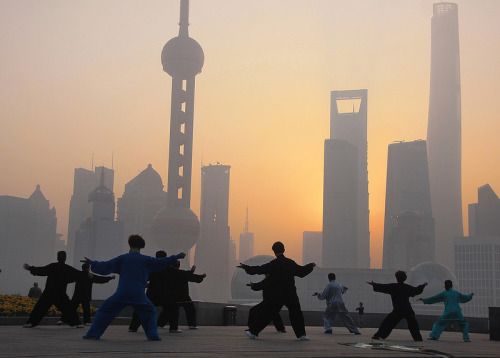
Original article and pictures take assets.tumblr.com site
Most people who have experienced this ancient Chinese martial art know that it improves balance and strength, giving practitioners a healthy workout with lasting effects. But tai chi first spread in China largely because of its capacity for pain relief, a benefit that is underappreciated by some and forgotten by others.
Tai chi helps people find balance in their minds and bodies, and that is one of the ways to be truly healthy. However, there are some specific health benefits as well, especially with regard to conditions which afflict millions of Americans.

Most people associate tai chi with groups of people in parks who move very slowly in unison. Such controlled movement has some significant benefits for your back. Yoga works wonders for many people, but its lack of movement sometimes prevents dramatic results in terms of back pain. Likewise, running is very good for many people, but the jarring motion can exacerbate back pain instead of relieving it.
Moreover, in addition to movement, tai chi promotes good posture. Slouching and rounded shoulders are unhealthy in addition to unattractive. Such a position places undue stress on certain areas of the back. After much practice, tai chi eventually trains the body to correct these issues, thus promoting back health.
This same irregular stress occurs if a person’s everyday movements, such as walking and standing, are not properly aligned. The resulting lack of balance and perception creates a fertile environment for back pain, especially since these movements are so incredibly common. The scientific term for this lack of balance is proprioception, which is essentially a flaw in the body’s inherent position sense. Tai chi often corrects this problem as well, creating a balance where it did not exist before and thus promoting back health.
Poor muscle tone contributes to many back pain issues as well, and tai chi effectively addresses this issue. The slow, controlled movements build core strength, and since these muscles wrap around the spine, stronger abs usually mean better posture. The same thing applies to hamstrings and other muscles which directly support the spine.
Finally, tai chi may alleviate stress-based back pain. Such negative energy almost certainly exacerbates back pain, and may even cause it outright.
Tai chi significantly reduces back pain in many people, even hard-to-treat conditions like sciatica and herniated discs, but almost never alleviate it altogether. So, tai chi is part of a solution as opposed to the entire solution. In combination with massage, cold and heat therapy, topical aids, even pharmacological intervention when necessary, tai chi can play an integral role in a back pain treatment plan. Don’t miss this guide to find the best massage ball for back pain, and combine daily use with a tai chi routine to start seeing results.
The movement/inner peace combination is often effective against chronic pain as well. Shifting mental focus away from discomfort and towards something productive often alleviates pain, and it can be several hours before pain signals from nerve endings regain their prior intensity. Meanwhile, the slow motion is very good for achy joints. Some specific examples include:
Once again, tai chi is probably not a magic bullet. For the best chronic pain relief, combine this exercise with other treatments that your doctor recommends.

The physical benefits of tai chi often emerge after several months of sustained practice, but the stress relief benefits are often apparent almost immediately. The stretching-and-releasing motion promotes physical relaxation. As a bonus, the tools learned in tai chi may be effective during those parts of the day when stress levels are at their highest. Furthermore, the deep breathing and soft commands from the instructor promote mental relaxation, extending stress relief even further in many cases.
Getting started is one of the most difficult parts of tai chi because it is so unlike most other Western pain relief methods. But tai chi is an evidence-based pain relief method, and if you suffer from stress or chronic physical pain, almost anything is worth a try if it might possibly break the grip of pain.

Let’s start with a great definition of Qigong and then discuss what role qigong plays in your tai chi development.
Dr. Gayl Hubatch, in Fabric of the Soul, sums up the process of qi gong development nicely. “Coordinating breath, intention, and movement increases energy flow. Increased energy flow is healing and restorative.” Eloquent and simple. We engage in tangible, understandable activities (moving, breathing, intention) and reap health benefits.

The tissues and fluids of the body are made up of minerals and chemicals with magnetic properties. The earth is a magnetic field and food and air also serve as energy. We can perform activities to alter blood flow and temperature which interacts (matches) the earth’s properties. These properties are closely aligned with what we conceive of as healthy.
Practitioners of tai chi are normally pretty open to anything. They hear of qigong and want to feel what is described and begin by being quite hopeful. With an understanding of the full developmental progress we can stop doubt from creeping in.
I am going to provide a spectrum of development based on my interactions over the years. Insert yourself into this paradigm and see what’s to come.
| Let’s Bake a Cake | |
|---|---|
| Turning the oven on | A practitioner is brand new. Their interest is piqued and they are just learning to relax into a meditative stance. |
| The oven is heating up | Progress at relaxation allows the energy to move around the body correctly |
| All the ingredients have been found | They are interested to new terms like dantian and are actively trying to use them |
| The ingredients get mixed | They can think about their center when meditating and have an understanding of keeping their hip joints, arm pits, lower back soft. |
| The oven beeps and is hot enough | A different sort of warmth, from the inside exists after practice. It is general and fleeting |
| The ingredients are one big blob and enter the oven | The body moves collectively or in order from the center out |
| A quick initial rise happens | Intention on the hands or dantian yields a perceivable heat that goes away |
| A long time passes and the cake browns | We work to try to make this feeling come back and it does at times. Our overall relaxation and higher body temperature come quicker |
| We check it with toothpicks and send it back in for more time | We can warm our hands and loosen our center easily. |
| Time for frosting | We can create and feel energy and can bring it to one spot within the body if we concentrate on the spot |
| Time for decoration | We can move the energy in specific directions, alight on a space and move on to another |
I hope this playful explanation hints at the huge amount of foundational work that you are benefiting from when you “don’t feel anything.” We are talking about interacting with autonomic processes and being able to affect your health, literally, from the inside. Of course this process shouldn’t be quick or easy.

Some research indicated that traces of a wide acceptance of Tai Chi were found in the village of Chen. This was the time of Chen Wang Ting during the early 1600s. Documents have it that this is the place where Tai Chi was born.
One of the legendary and respected founders who created the idea of imitating the flow and motion of the different martial art and kung fu techniques is Chang San Feng. By combining the different principles of Taoism, kung fu, and the theory of Yi Jing, he created the ever popular form of meditation, Tai Chi.
Characteristic
Tai Chi stresses to its practitioners that they must observe proper breathing, and correct posture so as to facilitate the pattern of the flowing Chi. Tai Chi can also be used as a form of self-defense but as time moves forward, it is less stressed.
Schools
Today, there are four popular schools of Tai Chi-Yang, Wu, Sun and Chen. These four are all unique in appearance and method of instruction but all follows the fundamentals of the basic principles applied in ancient Tai Chi that consists of cultivation of chi, correct posture, and principles of breathing.
Yang Style
This is the most famous and popular form of Tai Chi. In this kind of style, the body emphasizes a consistency regarding its movement speed, smoothness and slow but refined motion with continuity through the entire session.
Chen Style
When the Chen style of Tai Chi is performed, it features a motion that is in slow portions but then builds a stronger inner chi. it also exhibits a more explosive form with a fast turning when attacking. The back foot remains the same with the Yang style but as to being straight, it maintains a bent back knee.
May be quite similar to the traditional style of kung fu San Diego wherein stances are opposite to that of the Yang and Wu styles. All stances are often done in a low state and have a bit of an external feeling.
Sun Style
This type of Tai Chi was created in the year 1914 by Sun Lu Tang. By combining the three together with the theory supported by Yi Jing, principles of Taoism, and Qigong, he created a new and unique style of Tai Chi.
Wu Style
Considered as the youngest, it represents high stances and much slower movements. The front stances are parallel. This type of Tai Chi introduces a lot of reaching and leaning movements that are more controlled and slower than the rest.
By combining the different principles of Taoism, kung fu, and the theory of Yi Jing, he created the ever popular form of meditation, Tai Chi.
When the Chen style of Tai Chi is performed, it features a motion that is in slow portions but then builds a stronger inner chi. By combining the three together with the theory supported by Yi Jing, principles of Taoism, and Qigong, he created a new and unique style of Tai Chi.
Tai Chi stresses to its practitioners that they must observe proper breathing, and correct posture so as to facilitate the pattern of the flowing Chi. Tai Chi can also be used as a form of self-defense but as time moves forward, it is less stressed. Incorporating Tai Chi, can enhance one’s martial arts longevity.

Myth: You have to get your heart pounding and sweat glands pouring to get any kind of benefit from exercise. Fact: Even gentle forms of exercise like tai chi, or t'ai chi, and qigong can have major health benefits, according to research by Sala Horowitz, PhD, published in the journal Alternative and Complementary Therapies.
"T'ai chi and qigong are traditional Chinese mind-body disciplines that have gained popularity in the West for their health benefits," says Horowitz. "These interrelated practices have also received attention from researchers as complementary and alternative exercises for promoting overall well-being, as a fall-prevention strategy, and as adjunct therapies for addressing a wide range of conditions."
Not only are doctors and researchers recommending these meditative practices to their patients, but they're also doing them themselves. Both of the authors of Ultimate Immunity, Elson Haas, MD, and Sondra Barrett, PhD, have practiced tai chi and qigong, respectively, for more than 20 years each. "More than 20 years ago, I decided to study qigong," says Barrett. "I found a qigong master in San Francisco and studied with him to explore the energy of qi. In all this time, I've rarely caught a cold or the flu."
Most Westerners are more familiar with tai chi, however its origin is in its 5,000-year-old parent qigong. As practiced in the U.S., they are often interchangeable.
What Is Tai Chi
"Tai chi, a martial art that originated in China from qigong, emphasizes long, slow, continuous movements along with breathing and meditation," says Haas. The meditative state of this soft martial art comes from paying attention to the sequence of movement and keeping the body and mind present in the movement.
"As with yoga, there are many different forms of tai chi," says Sondra, "and medical research has demonstrated that when people who are 55 years or older practice tai chi, they can improve their balance, mobility, mood, and immune health."
The Benefits of Tai Chi
Improves Balance and Prevent Falls
According to Horowitz, tai chi is recommended by the American Geriatrics Society and the British Geriatrics Society to prevent falls because it targets balance, gait, and strength. This has been found to be true in healthy seniors as well as older adults with Parkinson's disease, adults recovering from a stroke, and patients treated for distal symmetric polyneuropathy.
Improves Immunity
Tai chi has favorable effects on cell-mediated immune parameters and antibody responses, cites Horowitz. This finding doesn't surprise the authors of Ultimate Immunity because of its connection to balance improvement. Haas explains, saying, "If you're afraid of losing your balance, you'll be less likely to be physically active, which is essential to your immune health."
Improves Heart Health
Various studies have found that tai chi can help lower high blood pressure, lower LDL (bad) cholesterol, and raise HDL (good) cholesterol, cites Horowitz.
Improves Quality of Life
Aerobic exercise may be able to improve your mood, but tai chi takes it to the next level. Horowitz cites studies that show that tai chi improves self-efficacy (or the belief that you have the ability to achieve your goals), locus of control (or the belief that you control the outcome of your life versus uncontrolled, external forces), and hope.
Lessens Fibromyalgia
Fibromyalgia is a musculoskeletal condition characterized by pain, fatigue, and sleep disturbance. Rather than load up on painkillers and sleeping pills, Horowitz cites research finding that tai chi not only reduces the pain from fibromyalgia, but it also reduces the number of tender points and fatigue.
Improves Your Mind and Outlook
The mental benefits for tai chi include improved cognitive function, reduced ADHD symptoms, and reduced depression and anxiety. In fact, Horowitz points out that medication plus tai chi is a better treatment for anxiety than medication alone, and that adding the physical component reduces rates of relapse.
What Is Qigong?
"Qigong, the 5,000-year-old parent of tai chi, is a series of meditative movements that emphasize the cultivation and balance of qi (chi), or vital energy," says Barrett.
Haas explains that according to Traditional Chinese Medicine, qi flows through the channels of the body called meridians and a blockage or imbalance of this energy can result in illness.
Qi is stored in three "cauldrons" in the body called the dantiens, "The lower dantien is about two inches below your navel, deep inside, and is said to be the primary storage area where qi energy can be built. The heart-center area (the middle dantien) holds another quality of qi thought to be more the emotional center, and the upper dantien, on your forehead (the third eye area), holds "shen," or spiritual qi," says Barrett. She explains that we can feel qi the easiest in palms of our hands.
Even if you don't take stock in this approach, there are still benefits to the practice. (Going only by this list, it might seem like there are fewer benefits to this practice, but that's only because in the U.S., tai chi is more commonly practiced, so there's more data.)
The Benefits of Qigong
Reduces Frailty
It's a stereotype that the elderly population is fragile—one that those who practice qigong don't fit into. Horowitz cites research that found that previously frail individuals improved their grip strength, heart rate, and overall health by starting a qigong practice.
Reduces Pain
Qigong is good for all kinds of pain, according to Horowitz. It reduces chronic neck pain, pain from osteoarthritis, and pain from fibromyalgia.
Improves Mood
Stress can really crush a good day. That's why it's not surprising that Horowitz found that qigong, which reduces biological markers of stress, also improves mood.
Try It: The Core Wave
Not sure if your body will agree with tai chi or qigong? Try this core wave movement from Ultimate Immunity. (Note: While this movement should be performed standing, it can be adapted to sitting or lying down.)
For more on qigong routines, check out Barrett's downloadable video, Logging On.
Bring your hands below your lower dantien (below your navel) with palms facing down. Move them toward your sides, keeping them in front of your body. Lift your arms and hands until they're chest high. Lift and lower. Keep your shoulders relaxed and your arms soft and rounded. You may feel your back getting into the motion; go ahead and gently bend your knees and rise up. You are indeed doing wavelike movements.

Get More Cool Videos - Subscribe ➜ https://goo.gl/4HvD8g
FREE Wing Chun DVD ➜ http://bit.ly/FreeWingChunDVD
Learn tai chi self defense techniques. T'ai Chu Ch'uan martial art moves for fighting.
Tai Chi combat self defense techniques #5 - Cloud Hands
See the other 5 techniques in this video:
https://youtu.be/two4qe0HxiA
Get Your FREE Wing Chun DVD yet? Limited Copies! Grab it Now!
➜ http://bit.ly/FreeWingChunDVD
POPULAR VIDEOS
Wing Chun Martial Arts Techniques
https://goo.gl/afS3HH
Tai Chi Lessons & Techniques
https://goo.gl/q5VrfO
Street Fight Self Defense Techniques
https://goo.gl/W7G0qc
Ask me a Question
http://wingchunkid.com/contact
Sifu David a.k.a. “The Mind and Body Mentor”, is one of the most influential and respected teachers in the personal success and development space.
David has always had a fighting spirit even at a young age and comes from a family with a deep martial arts heritage. As a physically smaller kid he was often bullied by the larger kids in his school. Fortunately, he would fight back which eventually caused the bullies to leave him alone.
Later in his life however, he was severely assaulted which led him to take martial arts training more seriously. It didn’t take long for him to gain the techniques and confidence needed to defend himself effectively.
In additional to being a 3rd generation Bruce Lee student and also 3rd Generation Ip Man Student, he has studied with masters from around the world, from various martial arts styles from wing chun, jeet kune do, tai chi, chinese kung fu to jiu jitsu and military combatives.
It is his passion and life goal to continually stretch his limits to attain knowledge, wisdom, success and new abilities while helping others in the process who are searching for their path.
His training style is unique as it transforms not just the body, but also the mind and spirit. He takes transformation to a whole new level with insight on meditation, body-electrics (chi), and spiritual technology.
He is truly one of the extremely rare teachers who successfully blends ancient martial arts principles into modern day life, spirituality and personal success.
To start your own journey with wing chun training, you can get his free Wing Chun 101 DVD here (just pay shipping):
http://bit.ly/freewingchundvd
★☆★ Check our other wing chun techniques training videos:
https://www.youtube.com/playlist?list...
★☆★ Learn basic tai chi and qi gong:
https://www.youtube.com/playlist?list...
★☆★ More self defense techniques in this playlist:
https://www.youtube.com/playlist?list...
Subscribe to our channel
https://www.youtube.com/c/wingchunkid...
Connect with Sifu David
Official site: store.combativewingchun.com
Facebook: http://www.facebook.com/wingchunkid
Twitter: https://twitter.com/thewingchunkid
