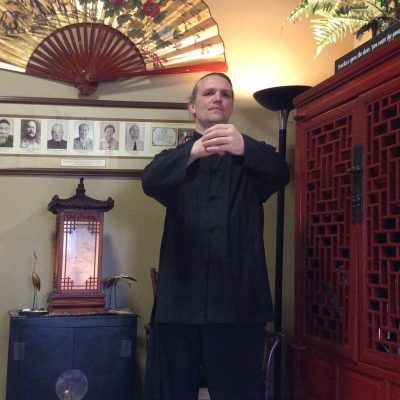
This is a video clip of Master Chen Zhonghua demonstrating a method to keep the center from the opponent. It is filmed at the monthly Maple Ridge, B.C. Canada workshop on Jan. 16, 2010.
This posture is Tai Chi. It is the most common of all the tai chi (taiji) and qigong (chi-gung) postures, and is often used as a separate exercise to increase leg strength, concentration, deep breathing and chi (qi) flow.
The stance and directions shown here are for a posture and standing meditation known as the Zhan Zhuang or Embrace the tree posture. The advice is sound for this posture though readers should be aware that Tai Chi and Yiquan (a standing meditation internal art) work a traditional Horse Stance as well which is a wide and low position.
Turn the toes in so the outside of the feet are parallel. Original article and pictures take www.wikihow.com site
Tai Chi Chuan (Taijiquan) is an ancient Chinese "internal" or "soft" martial art often practised for its health-giving and spiritual benefits; it is non-competitive, gentle, and generally slow-paced.[1] Contrary to the Western concept of "no pain, no gain," one hour of tai chi actually burns more calories than surfing and nearly as many as downhill skiing, so it's definitely a veritable workout.[2] But that's just one of the many benefits! By increasing strength, flexibility, body awareness and mental concentration, tai chi can improve your health, too.
1 Warm up with proper breathing and centering. As with any martial art, it's not just how quickly and forcefully you can strike a board or knock a guy out. A huge part of it is having a firm grip on your mind. To clear yours, focus your chi, and tap into your potential, you'll need to start with proper breathing (which will, in turn, centre you).
Put your feet up to shoulder width apart, no further.
Place your hand on your lower abdomen, about 2 inches (5 cm) below your navel. Push in lightly.
Breathe in and out through your nose slowly (lips loosely together) from this area of your abdomen. If you can't feel this area moving, push in with your hand a bit more.
2 Concentrate on all parts of your body one at a time. Once breathing like this feels normal, start relaxing every part of your body one at a time. Start with your feet and work your way up to your scalp. Get as tiny as you'd like -- down to your fingernails even. You'll find you were holding tension without even realizing it.
If you start to sway, that's actually a good thing! It means you're relaxing and your body isn't tensed to balance. If that does happen, consider slightly readjusting your feet or moving your concentration back to your balance until you're steady again.
3 Root yourself. One of the concepts of tai chi is "rooting." It's fairly self-explanatory: imagine roots growing out from underneath your feet. You are a part of the ground, never losing balance, focus, or your centering. Your limbs sway like branches in the wind, never hesitating for fear or apprehension. You are rooted.
This does not mean you or your legs are stiff. Quite the opposite. Just imagine roots under you, a part of you, allowing you for freedom of movement because you cannot fall, you cannot fail, and you will always be a part of the natural world.
4 Think about your frame. In Tai Chi, there are a few forms your positions can take. Generally, each style favors a specific form. Here's a rundown of the basics:
Small frame style. In this style (usually Wu or Hao versions) aren't very expansive. The movements are smaller (big surprise, huh?) and there's less extension in general. The focus is on correct internal energy to form correct movements and transitions.
Large frame style. The large frame style (Chen and Yang) involves low and high stances, more dramatic postures, and swinging arms. It emphasizes correct positioning of the body and alignment to channel energy.
5 Experiment with different styles. Because all Tai Chi is good, it's more important that you do any rather than worry about which style is right for you. But once you get immersed in the world, you may want to experiment. Here's a brief rundown:[4]
The Chen style mixes up the tempo, going very slow and then being explosive. It can be difficult for beginners.
The Yang style is the most popular. It has a steady tempo and, as discussed above, uses large frame movements. It's probably what you think of when you think of tai chi.
In Wu, the movements are almost microscopic. This makes it easy to do, but difficult to master -- there's a lot of focus on powerful flows of energy and inner, pressured movements. The movements are very slow and deliberate.
The Hao style isn't very widely spread. You probably won't find a teacher that practices it.
1 Master the moves by understanding the philosophy and its makers. To understand the nature of Tai Chi Chuan (meaning "Supreme Ultimate Fist") we have to put it into context with the culture from where it has come. This means we have to look closer at the Chinese culture and, in particular, the spiritual tradition of Taoism which is where Tai Chi Chuan finds its roots and sustenance.
The art of tai chi is said to improve the flow of Chi (Qi), the traditional Chinese concept of a physically intangible energy or life force. In scientific studies, tai chi has been proven to improve a host of medical conditions including, but not limited to: muscular pain, headaches, fibromyalgia, cardiovascular problems, arthritis, multiple sclerosis, Parkinson's, Alzheimer's, Diabetes and ADHD. Though its low-impact workout is especially helpful to seniors, tai chi is for everyone and is deceptively simple in appearance.
The thing to keep in mind about Taoism is that it is about an attunement with nature. Not just nature outside of us, but also the nature within us. This principle is called Tzu Jan, or Ziran in pinyin, and it is the principle of being "self-so" or embodying one's "self-nature". So beyond the health benefits and stress relief, Tai Chi Chuan is also a means to tap into one's inner self.
3 Try the single whip move. We're just going to outline a few here (there are tons), but a pretty standard one that is seen in every variety is the single whip. It's where every point along your arms and upper torso is part of a whip -- they could explode with a force of energy at any moment, becoming the end of the whip. Doesn't seem so effortless now!
For this move, generally one hand stays in the "beak hand" position. You can probably guess why -- it sort of looks like a bird's beak. Your four fingers should be lightly touching your thumb and your palm should be facing downward. As for your arms, each style of Tai Chi is slightly different, but generally, they're at shoulder height and spread like loose wings.
4 Do the white crane spreads wings move. For this one, your weight should always be on one leg -- but both feet should always be on the ground. You'll be shifting back and forth as you test your balance. So to your arms should be opposite -- one should be moving fast and on different planes and the other should be slow and deliberate (but never flaccid and weak).
The name of this moves sounds docile, but it does have a fighting application. Think about it: your weight and arm position is always changing. And when you have 100% of your weight on one leg, it frees the other up to kick. There's your purpose!
5 Practice "pouring." This can even be something you do waiting in line at the self-check out. You simply stand with your feet on the floor, parallel, shoulder-width apart. Then you pour your weight onto one leg and hold; after a few breaths in and out, you begin slowly pouring your weight onto the other leg and holding. Do this for a few minutes, clearing your mind and becoming aware of your balance.[5]
6
7
8 Go from short form to long form. For most beginners, you'll probably want to stick to the short form. That's 13-40 moves long and generally lasts about 5-20 minutes. But once you get that down, you may be craving more. That's where the long form comes in! It's 80 or more moves and can take over an hour.[7] Talk about stress relief!
Original article and pictures take www.wikihow.com site
When I started learning Tai Chi in 2004, I went to a school where it was not allowed to practice barefoot. So I started my quest to find the best Tai Chi shoes.
I will talk you through the different options I’ve tried and I am sure you will find your best Tai Chi shoes, too! Just click on the pictures and you will be lead to Amazon so you don’t have to search for them.
Choosing the best Tai Chi shoes
In the very early beginning of my Tai Chi practice I did train in socks. And I still recommend them if you do only Qi Gong or if you just started. But just socks felt somehow “slippery” to me.
Then I tried these socks with the little rubber things on them. However, I feel uncomfortable to make turns or sliding steps in them. They will simply stop – that’s what they are supposed to do!
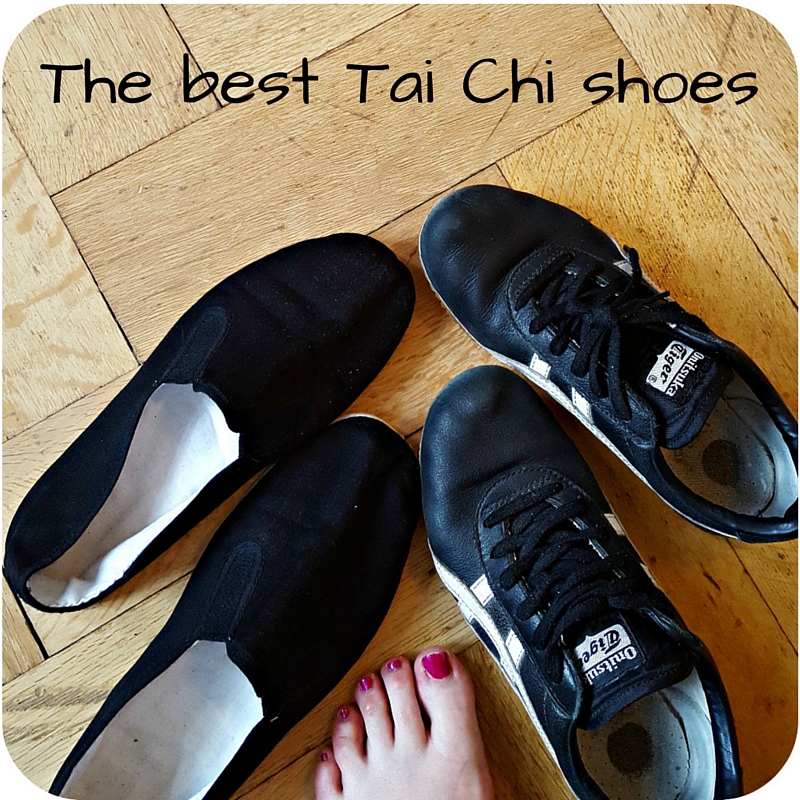
Thus I really prefer to wear shoes for Tai Chi to feel more grip. To me, wearing shoes to practice is also like a small ritual: I put on my shoes and I know “now it’s practice time”. For practicing Taijiquan indoors I like to wear fabric Tai Chi slippers like these:
The advantage of these is that they are quite cheap. You can get them at Amazon or in many Chinese shops. They are light weight and you instantly look like a “pro” ! However, they have no rubber or anything on the sole so they are a bit slippery. Don’t ask me why, but after a couple of weeks they won’t feel that slippery anymore. Another reason to practice daily!
And I would not recommend to wear the Tai Chi shoes with the cotton sole in the park or in grass because your feet might get wet.
If you want more grip, these simple shoes are also available with a rubber sole.
However, I prefer the ones with the cotton sole. My feet are less sweaty in them and I personally do not like to wear rubber soles inside.
And I would not recommend to practice outdoors with them either because the fabric would get wet (unless you only practice in the sunshine anyway!).
If you would like to have even more grip and more foothold you could choose some of these Tai Chi shoes:
Feiyue shoes are quite popular, you’ve probably already seen them on your fellow Tai Chi practitioners. They have a rubber sole for more grip. As you can tie them they give you more foothold. The shoes are available in black or white, and even as high tops.
You can use these shoes for Tai Chi outdoor, too. Just remember that if you want to use them in- & outdoor ask you teacher if that is ok. Some do not like to have outdoor shoes in their indoor training place!
However, I personally do not wear this footwear, because when I train indoors I prefer the light weighted fabric version.
And outdoors I have to admit that I prefer a more “chic” version. (Ok, I am really a girl!) But I usually bring my children to their daycare and practice in the park after that. I simply do not like to wear “fighting” shoes when going to a kindergarten! So for practicing in the park etc. these are my best Tai Chi shoes:
The Onitsuka Tiger Tai Chi shoes are basically training shoes with a REALLY thin rubber sole. They are very comfortable and you can wear them “in normal life” as well as on the training ground! I bought mine many years ago. They are hard to get, but if you find them, I really recommend them! (fun fact: the Onitsuka Tiger Tai Chi shoes in yellow were worn by Uma Thurman in the movie “Kill Bill)
Now you might wonder: why can’t I wear normal athletic shoes to practice Taijiquan and Qi Gong? If you really need a lot of foothold it might even be an option in the very beginning. But with such thick soles it is not quite possible to role your feet. You are simply not that sensitive with a thick layer of rubber clasping around your feet and toes!
Additionally, Tai Chi and Qi Gong are both great practices to train your feet. Give them a rest and do not surround them with that much rubber and fabric all the time! Walk and train barefoot whenever you can. Your feet will get stronger and more flexible and it is just a nice feeling to let them breathe and feel the ground!
In class, as we learn how Tai Chi targets fascia and connective tissues through intelligent, conscious movement, we often hear Sifu Michael Paler say things like:
“Gently stretch from your hip to your armpit.”
“Stretch the arms forward, elbows down and away from the upper backbone, and spread the tissues away from the spine. As if if a sphere is expanding.”
“Always lift the crown of the head, sink the tailbone. Open and engage your hands and surrounding tissues while exercising.”
These gentle fascia stretches are not at all like a yoga stretch that you are instructed to hold. Our goal is to engage the fascia and connective tissues and to release and melt away the tension. The feeling of this type of stretch is more like a yawn. Targeting fascia doesn’t feel at all like targeting muscle, you learn to stretch and use your fascia and connective tissues by focusing on gently stretching the skin and other connective tissues that are located just under the skin layer. As the skin stretches and expands like a balloon, so do all the muscles and tissues below it. The practitioner will, with practice, eventually feel like “a balloon person” while doing Tai Chi!
A more effective way to target fascia: The video below is a warm-up exercise we use in class daily for this purpose. Then, after the warm-up, we continue working the fascia by doing our Tai Chi Forms and various qigong exercises. We know that moving in this way hydrates the bones and tissues and gets the bodily fluids moving, thereby preventing dehydration and the breaking down of bone and tissues that cause us to become stiff and brittle as we age.
Fascia and Connective Tissue Targeting Exercise – Tai Chi Stretch and Warm Up (Jibengong) — Tai Chi Joint Opening Exercise (Kaimengong)
Head gently lifted and tailbone dropped, elongating the spine, 2. Shoulders and elbows down, etc…
We are working to open, hydrate, and lubricate the joints, ligaments, and vertebrae by gently stretching and making more elastic the veins, arteries, nerve tissues, and other connective tissues. The art of Tai Chi Chuan has been developing the fascia as a source of power in this way for hundreds of years. So, this is not a new concept at all but ancient in its origins. Our goal is to relax the nervous system, open the meridians, stretch fascia and skin, and sink and release the muscle and bones in order to gain access to and develop these powerful fascial lines.
“Chi” and fluids (QiXue) circulation is just one method we use in learning how to sink and pull fluids up through the body to create power. This kind of movement is like a kinetic chain of energy and creates whole body power.
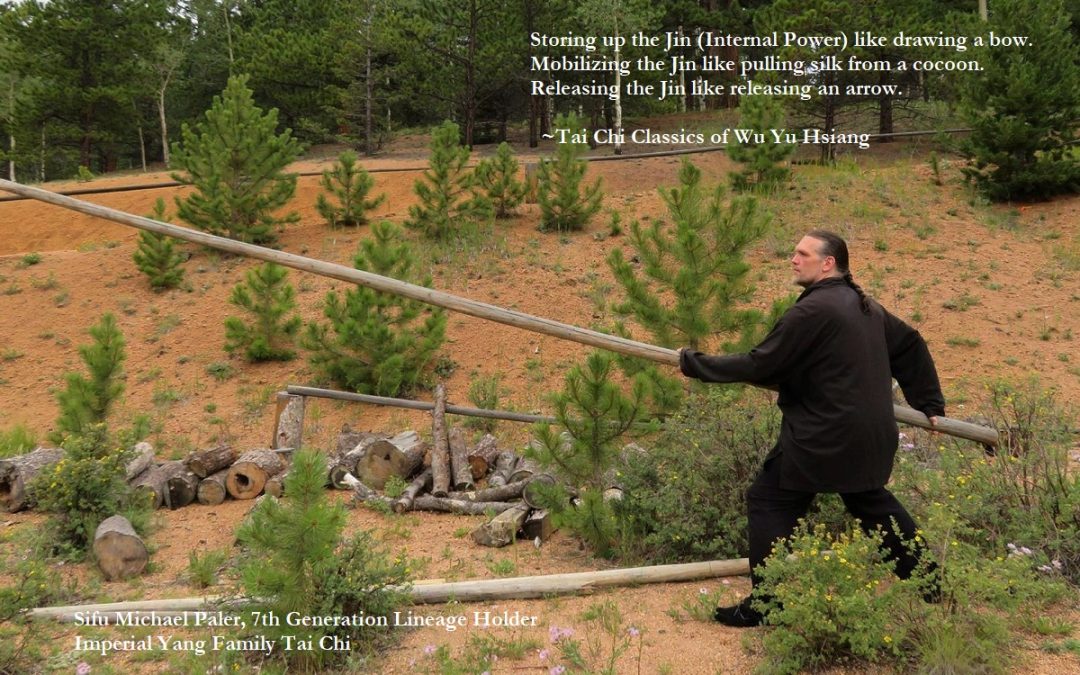
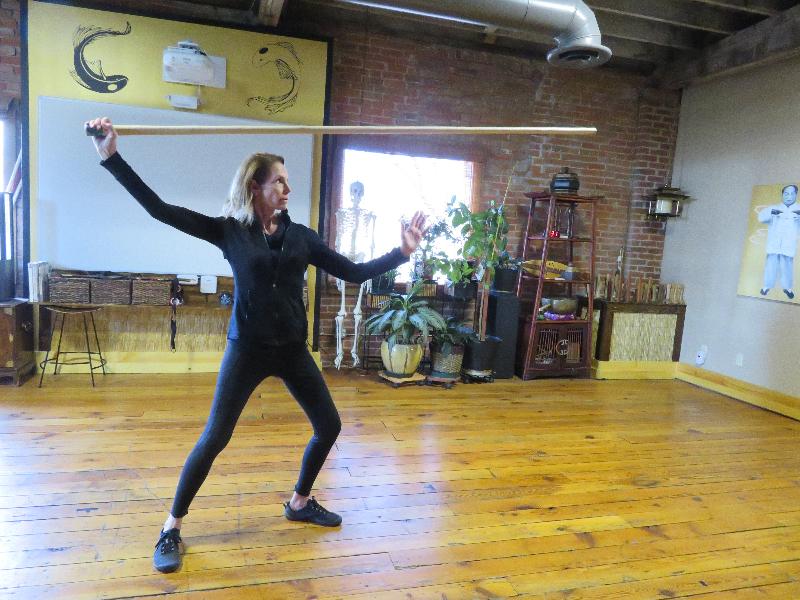
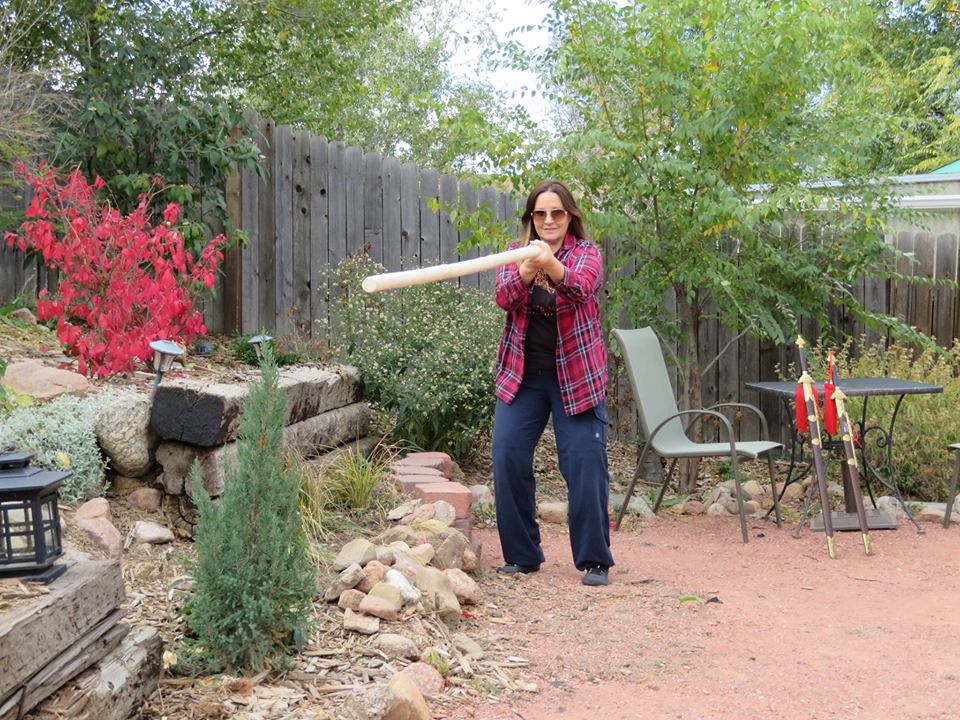
About the pictures below using the staff and spear: Every time we hold the spear one way, our bodies stretch a certain way to power the body. When we hold the spear in another posture, our body seems to organize itself by stretching in a different way. We are not using muscle alone to achieve this, but we have worked for many years now to develop our fascial lines to gain whole body power. Developing the body the Tai Chi way leads us to more skills, benefits, and abilities. The 8 Energies of Tai Chi, Fajin, increases power for both healing and martial arts.
Kathy practicing “Daoist Immortal Pointing the Way” training Tai Chi’s integrated whole body power Silk Reeling “Power Lines” of Chen Family Tai Chi, the tissues are developed this way after many years of training Chan Su Jin (Silk Reeling Power)
Once we can move past this elementary phase of stretching the fascia and connective tissue, and releasing the muscles and bones, then the next step is to very specifically develop the fascia and connective tissue into what our school refers to as “Power Lines” (Jin – power and Luo – channel). These elastic, whole body lines of power allow the Tai Chi student of any age to perform incredible martial feats; even a small woman can gain the upper hand in a conflict by utilizing this type of training. This is because in Tai Chi we don’t rely on muscle strength alone; in fact, it’s the fascia and tendons that create the majority of power that we use. Of course there are many great ways to develop health and power in your body, Tai Chi is just one of those ways.
We achieve this by adhering strictly to the 13 Principles of Yang Cheng Fu. It is important to note that different lineages of Tai Chi all develop the body in somewhat different ways, but with similarities, all using their own set of Tai Chi principles and techniques unique to that particular lineage. A good example of this is: In Yang Family Tai Chi, silk pulling (“silk” meaning fascia) is a signature method and skill of Yang Lu Chan and the Yang Family Elders, much the same as silk reeling is a Chen style signature method and skill. Another example would be a baseball pitcher, who throws the ball overhand thousands of times. This would be similar but different to another pitcher who throws underhand for the same sport. Each movement and intent develops the body differently. And such is the case in many exercises. Without proper instruction and understanding, one can develop the body incorrectly.
Julie using her “Power Lines” to hold her 9ft, five pound Tai Chi Staff
Developing whole body fascial lines -v- isolating muscle alone: By developing the fascia you work everything in the body that the fascia encompasses, including the muscles. Exercising in this way, we do not create stress and tension while in movement like a person does when they only engage muscle groups. There’s NO contracting, No impacting, and No stress — because in Tai Chi we do not hold a stretch, rather we “fang song,” we it let go. Tai Chi is the art of letting go, and the result is soft, springy elastic power, like we experienced in our youth in abundance. By practicing in this way, you will train yourself to relax while in movement and also in stillness, and not just in the mind, but in the whole body. You do not have to work just fascia or muscle; you can work all of it at the same time using these Tai Chi principles and methods.
Just a few of the many health benefits: beautiful naturally toned muscles, youthful smooth and healthy skin, a relaxed nervous system, elastic veins and arteries, healthy organs, a relaxed decompressed spine and spinal cord, and the list goes on and on…
Mind/Body Targeting: In this mind/body practice you learn to feel inside your body. You’ll begin to map out where each and every organ, nerve, muscle, and tendon is located, and, in time, you will know how to gently massage, or relax and release, them through targeted conscious movement. You will learn how to regulate the movement of bodily fluids, allowing you to do such things as manually lower your blood pressure when needed, and to release tissues and muscles that are tight and painful. This allows you to take control of your own body and regain your power, for this is your intrinsic right. Being able to Song, San Tong, Kong — “let go” and relax, connect and empty — is a Gongfu (a learned skill) of its own. And as our physical bodies experience “the art of letting go” physically, then our spirit, heart, and mind will have a clear path to follow. This is the work, but if we eat the bitter and do the work, we will taste the sweet.
On a personal note: I chose Tai Chi because not only did the methods I am sharing with you help me to be stronger than ever before, but they also helped me to achieve many other life goals I had, such as sharpening my mind, and healing my body from past injuries. My husbands constant encouragement to keep going even when I felt the training was tough, and his willingness to always practice with me helped a lot too. Finding a good training partner is everything.
“In Tai Chi there is no recovery period, because Tai Chi is the recovery period.” ~Sifu Michael Paler
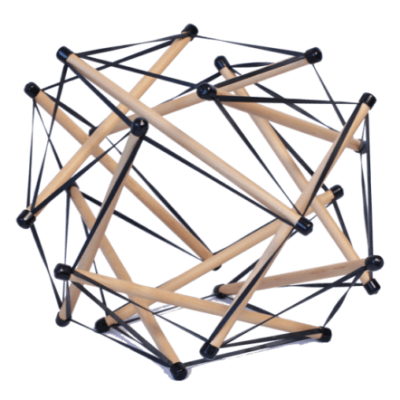
What is fascia? This somewhat trendy word is being used more and more by many in the health and fitness industry lately. Fascia is made up of fibrous tissue that contains very closely packed bundles of collagen, like a thin membrane that connects everything within the body, a continuous web of hollow, fluid filled strands. It’s the body’s natural shock absorber, a spring of energy that surrounds and infuses every structure in the body. These elastic tissues work much like a tensegrity balls rubber bands (shown in the illustration to the left). They connect the wood pieces together in such a way that the pieces of wood (bones) never touch each other which would create unwanted compression. In much the same way, fascia in the human body creates a matrix of elastic bands for our bones to float in, protecting each and every part of the body individually from impact. This self-aware matrix of elastic bands relays information to the brain faster than our nerve impulses. Neuroscientists now believe it is this amazing structure that carries our consciousness, much like a spider web that encapsulates every nerve, blood vessel, organ, muscle, bone, brain etc… And just like fiber optics, fascia carries and relays information from one part of the body to another as well!
Fascia Magnified 25x (Subtitled)
Where should I go to learn Authentic Tai Chi Chuan? This is what I can tell you from experience: A great Tai Chi Master/Teacher who understands and teaches all the things I have written about in this blog, is a rare find indeed; it’s like finding a pearl hidden in a field. First of all, seek out a teacher with authentic credentials and/or certification from a reputable source. This teacher needs to be able to instruct you in all the Tai Chi principles that are contained within the forms, because the Tai Chi form without the principles is empty and powerless for health or for self-defense.
Never think that just because a Tai Chi instructor works at a familiar local community organization that that instructor understands and can teach all these things. Unfortunately, there is not really a standard that companies or gyms use; and, in their defense, they really don’t even know what questions they should be asking new teachers. Some places do require a Tai Chi certification, but never really check into the background of where and who gave the certification or even how long it took to acquire. So, do your homework and be cautious. Also, you should never make your decision based on how it might be cheaper or a better deal financially for you. REAL TAI CHIis worth the investment in your health. Always look for a teacher who possesses in their body the qualities you want to achieve in your own body. Remember: a teacher cannot give you what they do not possess themselves. That said, there really are some amazing instructors out there; you just need to find them. If you cannot find a credible Tai Chi instructor in your area, we would encourage you to sign up for our Tai Chi Online Course.
Note: All the teaching and advanced training information offered in this blog was gathered by attending regular Tai Chi classes offered by Sifu Michael Paler!
Sifu Michael Paler, 7th Generation Lineage Holder, Imperial Yang Family Tai Chi, openly teaches these training methods daily in his Tai Chi School, the Tai Chi Association of Colorado Springs, and also offers this same training on his online learning site, www.TaiChiOnlineClasses.com. Although the online course is for long-distance training, we encourage students to visit Sifu Paler and learn hands-on at his Colorado school, via daily classes, workshops or our annual Tai Chi Colorado Mountain Retreat.You can get only so far on your own, but to reach more advanced levels, as the Tai Chi saying goes, “It takes 4 hands to learn Tai Chi”
Sifu Michael Paler also travels and offers workshops upon request.
Article written by Julie Paler
(Edited By: Melinda Erickson)
Related Articles:
Fascia Resources:
Original article and pictures take taichionlineclasses.com site
Nina Chen, former Human Development Specialist, University of Missouri Extension
Woman doing tai chi exercises outside
Tai chi is a slow motion, low-impact exercise that promotes physical and mental health and relaxation. It is practiced as an effective exercise for health through a series of flowing, graceful, gentle postures and movements. The gentle flowing movements contain inner power that can strengthen the body, improve mental relaxation and mobilize joints and muscles. Tai chi is an especially suitable therapy for arthritis because of the slow and gentle movements. Here are some of the benefits:
Tai chi improves balance, strength and flexibility and lowers the risk of falls. A study from the Oregon Research Institute found that tai chi improved balance and reduced the frequency of falls and risks of falling among older people.
Tai chi also reduces pain, stiffness and stress. Researchers from Tufts University School of Medicine noted that patients older than 65 with knee osteoarthritis who practiced a 60-minute tai chi class twice a week for 12 weeks showed a significant decrease in joint pain and stiffness compared with those in the control group. They also found the patients in the tai chi group had improved physical function, self-efficacy, depression and health status.
Both the Oregon and University of California-Los Angeles (UCLA) researchers reported that tai chi improves sleep quality in older adults.
Other UCLA studies also suggested that tai chi helps people reduce high blood pressure and tension headaches.
For people who carry extra weight and have a hard time doing exercises without pain, tai chi can be a gentle and safe way to get moving. By practicing tai chi and making wiser food choices, people can start burning calories and losing weight.
Tai chi is an inexpensive, safe, non-competitive exercise. It can be performed standing or seated. Almost anyone can learn tai chi regardless of their age or physical abilities. You practice tai chi at your own pace. It requires no special equipment and can be practiced anytime, indoors or outdoors.
There are many styles of tai chi with different forms in terms of physical exertion, appearance and training methods. Each style has its own emphasis on various tai chi principles and methods. Some of the styles are suitable for more athletic people with a martial arts focus. Other styles provide special healing and relaxation. A short form with smaller and slower movements is appropriate for beginners, especially older people.
It is important to find a tai chi form that is suitable for you and can meet your needs and interests. If you have any medical conditions or medications that can cause dizziness, talk with your doctor before starting tai chi.
Harmer, L.F., Fisher, K.J., McAuley, E., Chaumeton, N., Eckstrom, E., & Wilson, N.L. (2005). Tai chi and fall reductions in older adults: A randomized controlled trail. Journal of Gerontology: Medical Sciences, 60A (2), 187-194.
Irwin, M. R., Olmstead, R., & Motivala, S. J. (2008). Improving sleep quality in older adults with moderate sleep complaints: A randomized controlled trial of tai chi. Sleep, 31(7), 1001-1008.
National Institutes of Health, National Institute on Aging. Tai chi for older people reduces falls, may help maintain strength (Accessed on September 20, 2011)
Original article and pictures take missourifamilies.org site
High quality Hazer888 inspired Mugs by independent artists and designers from around the world. All orders are custom made and most ship worldwide within 24 hours.
Original article and pictures take www.redbubble.com site