When Tai Chi Push Hands, Tai Chi Steps and Tai Chi Posture come together producing Practical Tai Chi Fighting Technique
Introduction
First of all, I only present my opinion, this text is not a "final truth". There are Tai Chi schools, that practice different approaches, and nevertheless, achieve astonishing results. So, please, keep in mind, that it is only one of the possible viewpoints.
When teaching Tai Chi, we learn three aspects of it. The first one has to do with forms. A student need to learn the sequence of techniques, as well as some rules that should not be violated. Generally speaking, by performing forms (correctly!!!), one can achieve the energy flow, enter the meditation state and improve his / her health.
The second aspects deals with the fine mechanics of Tai Chi. Not just "follow these rules", but also being able to explain WHY the particular rule is important. In this text, I will focus on this aspect a lot.
And finally, the third aspect, the "chi". Using the energy flow to turn it into a Practical Tai Chi MARTIAL style.
However, here is the problem.
You see, I believe, that one can learn the form by the book, though, of course, a live teacher is always better. One can get some understanding of how and why the Tai Chi "rules" work - from the book. But I do not believe it is possible to learn the martial aspect of "chi" from the book, or, at least, it will require a much better teacher than I am.
Once again. To make your "chi" flow, you can use a book. It is rather simple. To make it flow in such a way, that your opponent looses his balance, takes a teacher, that is present in the same room, looking at you, correcting your mistakes.
I know of few Tai Chi schools that use this approach successfully, but there is no way to EXPLAIN the process with words, it is all about feeling.
Fortunately, there is another way.
The "fine mechanics" of Tai Chi, mentioned above, can be explained with words (though you need a partner, and preferably, a teacher, to master it). The result will be the same, as in "chi" approach. Actually, these two roads will take you to the same place, if you study the "fine mechanics", at some point you will perceive it as "chi".
So what I am going to do here, is discussing the mechanics of Tai Chi "inner" style, keeping in mind, that this is only one of possible approaches. I know, that some people will object against talking about "chi" as about balance and mechanics, but let me repeat, by following this approach, you will, at some point, notice that you have "switched" from mechanical to energy approach - and from that point, they are the same.
Also, this approach allows you to distinguish between good and poor Tai Chi schools, but this is definitely beyond the scope of this text.
Rules
These rules are universal. They apply to Tai Chi Push Hands exercises, to performing Tai Chi Steps and to achieving the proper Tai Chi Posture.
In Tai Chi tutorials, available on this site, "rules" are provided as list of "do" and "don't". Like "keep your lower back straight", and so on. Here I am going to examine some of these rules from mechanical point of view. Keep in mind, that I am only going to discuss martial applications here, not healing, meditative etc.
Always push back with your "min men" point
I use this rule a lot to explain what a correct Tai Chi Posture should be. Also, students violate it a lot, too. The idea of the rule is to make your lower back flat, rather than curved forward. As they say in ancient Chinese scolls, "Your back should be like back of a turtle".
Let's take a look at the way the person takes the punch in a chest.
As you can see, if there is a curve forward in the lower back area of the spinal cord, the punch (or a steady pressure, for that matter) will break the person's balance. While if this area is flat (curved back), the pressure "goes down, through the feet, into the ground".
This approach is part of the pressure absorbing technique, used in inner martial arts (you see it a lot when people practice Tai Chi Push Hands), when you push an opponent, and instead of falling, or at least, steppong back, he suddenly returns you this pressure, coming from the other hand and in the other direction.
Now let's take a look at the person, trying to push (Tai Chi Push Hands). He is using his hand, and the counterpressure goes through the shoulder. On the left, the person has his lower back flat, on the right, he makes an error of having it curved forward.
As you know from the elementary physics, the pressure cannot appear from nowhere. In our case, to push with the hand, we need to push against the ground, in the opposite direction. As you can see from the picture, if the lower back is curved forward, our own pressure is breaking our balance, while if the back is flat, the balance remains.
This rule comes together with its counterpart: always keep your coccyx turned forward. In most cases, it is the same rule. Let's take a look at the forces, affecting our balance, this time paying attention to the coccyx area. We will assume, that the force goes through the bones, which is pretty much true.
As you can see, if the coccyx is not aligned properly, the pair of forces (fron the pushing hand and from the ground) work together to turn it additionally, so instead of breaking the opponent's balance, we work on breaking our own.
By the way, part of the "sensitivity" of a Tai Chi practitioner, that I am going to discuss later, is directed at sensing such vulnerabilities in opponent's balance, and exploring them.
Always keep your neck straight, as if there is a force, pulling your head up, applied to the top of your head
Now, not following this one in a martial situation is a very bad habit. You may talk to boxers, to get an additional confirmation. If your neck is straight, then when you get a punch in the chin (the same way as with the lower back, discussed above), the energy goes down, by the spinal cord, dissipating there. If the neck is corved forward, it may produce a trauma, or even kill you. The "energy" mentioned here may come from the punch, or from one of the few martial techniques, when the opponent shakes your body in a special way 9so called "dropping the chi").
Tai Chi Posture: Limits
In this short chapter, we will only talk about few limits, as you get the idea, you will be able to apply it to other "limits" as well.
"Keep your armpits open". It means, the hand should not go: a) inside, this way if someone pushes you, you will not be able to resist. b) to the outside, this way, if someone pushes your hand back, you will have to push against a huge leverage. c) up, this way your shoulder will go up, and you will not be able to push forward. Also (see below), the energy you produce from your feet, will not reach your hands. d) down, this way (same in c) your opponent will simply punch you, as your hand is not protecting you from the frontal attack.
You shouldn't sit too deep, as at some point you will have to bend forward and to bring your coccyx back, both things compromizing your balance.
You should keep your elbows down whenever possible, as you will get kick in the ribs otherwise. Also, the higher the elbow, the longer is the leverage, in case pressure is applied to your hand in a backwards direction.
And so on - as always, for these strict rules, there are strict and logical mechanical reasons.
Practical Tai Chi: Energy, force, balance
Chinese are very practical people. So when you hear something like "Tai Chi works with natural forces", do not thing earthquakes or hurricanes. Think gravity, inertia, balance.
When it comes to the term "force", we will use one from the elementary physics. We push, an object pushes back. If forces are not aligned properly, either the object, or us, someone will loose the balance. Very simple. Now, what about the energy? (Once again - I am not talking about the "mystical energy" here, as I have no idea how to do it in a written text).
Let's take a look at a typical Tai Chi Fighting situation - you are in a "jun juan" or similar position, pushing your opponent away.
There are two "types" of hands present here: curved out (Yan) and curved in (In). Let's take a look at the "Yan" hand first.
The physical effort ("force") is directed by the red circle, when done properly, it feels like holding a large bag, or a tree (that is where the jan juan, the "big tree" term came from). This is NOT the push directed at the opponent! This is simply a version of a jun juan position.
However, the energy (green arrow) is directed at the opponent. He feels it as a pressure, and if asked, will probably say something like this (you hear it a lot when non-Tai Chi people try Tai Chi for the first time): "I thought it is a soft "inner" martial art. Instead, you are pushing with all the force you got."
They are wrong. There is no force involved. If you push, and an opponent suddenly jumps back, you will loose your balance. But if your force goes in a circle and is (by this circle) returning to you, then your opponent's retreat will not break your balance at all.
We will talk about it more in "structure" chapter.
Now, let's take a look at the "In" hand.
Again, there is a circle - this time, outer circle, present. It feels (for the person doing the technique) as if your hand is going by this circle, following the fingers. Yet, from the opponent's point of view, there is a strong pressure, directed at him (green arrow).
This simple mechanical concept takes us to the really advanced matters of balancing In and Yan. When you are in contact with your opponent, you can - provided some practice - feel his balance, and you can break it, as well as change your position (Tai Chi Steps), to regain the balance of your own. We will talk about it in the "structure" chapter, too.
By the way, by "when you are in contact with your opponent", I do not mean the wrestling. When he punches you, and you block the punch, it creates a momentary contact, and for an advanced practitioner of the inner martial style, it is enough to feel what should be done, to change the posture (see for example "absorbing the punch" discussed above in the min men section), and to do extra steps to break opponent's balance. It looks like the opponent is punching you and then falls, with no reason.
It may sound a bit too complex, and in a matter of fact, it is. Learning the inner style is not as easy, as learning the "outer" one. However, it is doable. As for the time required, I know a 18 years old girl, who got to this level in 1.5 years of doing Tai Chi for few hours a day.
Tai Chi Push Hands: The structure and the energy
For this simple exercise, you will need an assistance of someone weaker than you, perhaps a child. Stay straight, with your hand extended forward. Ask the child to push at your hand, to break your balance.
If you are strong enough, the child will fail.
Now, extend your hand to the side. The same child will be able to easily push you off balance, because the leverage now is much larger, or, as they would say in Tai Chi, because your limits are violated.
This was a simple, and not very "martial" demonstration. However, it is possible to take this same concept to a much more advanced level.
As always, let's start with the jun juan position (a frontal version of it). All Tai Chi techniques are just variations of this basic position. Now, let's say we want to deliver a push forward, and it is going to be a fast push. I do not use the term "punch", because in this case the hand is not going to move, the power will come from the body.
As you can see from the picture above, the pressure (the "energy") goes through the bones. Now, let's say we have violated the "shoulders down" rule, by bringing one shoulder up.
The result is going to be devastating - the energy, instead of going into the target, will add to the already existing twist of our body.
To make sure it is true, try to push the way shown below. You will notice, that it is not possible to create a powerful push, if your shoulder is up.
But wait a minute! Isn't is a famous "tiger" punch, one of the strongest and the most unpleasant in terms of blocking it? No. The push we are doing has its power HORIZONTAL, it goes parallel to the ground. In the "tiger" one, the push goes forward AND down, which is possible because of - sounds familiar - the "round back", and it is also solid, because the shoulder does not go forward and back in a shoulder joint. To achieve the last condition, you need to... bring your shoulder down.
Now, about the structure. In Tai Chi, it is the way of organizing your body in an intelligent way for EVERY situation. The way YOU do not spend energy, while your opponent still gets enough pressure coming from you. Consider an example from the "energy, force, balance" chapter. Let's say you hit something with a hammer. Then this "something" will be pushed away. If the last moment you remove this "something" from the hammer's way, the hammer wouldn't be able to stop, as it has a strong momentum. Now, consider TOUCHING the same "something" with the spinning wheel. Again, the "something" will fly away. But if you remove it from the wheel's way, the wheel will remain steady. No disbalance. More than that, the hammer takes the energy to work, and if you need to hit the second target, you need to supply it with more energy.
As for the wheel, it may spin, waiting (for a contact) infinitely, without loosing the energy.
This is what "the structure" is about. Except, as an opponent may attack in many different ways, there is no way to do the universal "ready for everything" structure. Instead, you need to get in contact, and the moment it happens, to change.
Tai Chi Martial Art: Changing
Let's say, for the sake of an example, that an opponent pushes you through your hand.
The pressure affects your posture, your lower back is not flat anymore, and you are bending back in the lower back area, which is the first step towards falling flat on your back.
To fix the situation, you need to change your position. First, you need to pull in your chest. This is a rather simple technique, but for beginners, it is usually a very hard to do. We do martial arts, to become stronger, right? Yet we know, that strong people have their chest FORWARD, not the other way around. Well... Not in Tai Chi.
By making your chest pulled in (think of breathing out with the chest area only, no stomach involved), you gain few inches of extra space. Then you continue to change, using these few inches as a start, and at the end you have your low back rounded again. The objective is achieved, we are in a stable position again.
For someone with the karate background, this approach may seem impractical and inefficient. However, when you master this technique, you should be able to painlessly absorb the punch in a chest. The body will adjust, passing the punch down, in the ground.
This same approach is used to send the energy from your feet, up to your hands (and then, into an opponent). It makes your attack way stronger, as your body is way stronger, then your hands alone.
Note, that by practicing this technique, you learn to feel, "through" the opponent's hand (or leg, for that matter), how is HE aligned. You also learn to easily break his balance. Let's say, you need to be pushed off balance for 1/2 of an inch, before you feel that someone is breaking your structure, while your opponent need a full 1 inch, before he feels it. Then you have an advantage. You do something - he responds WITH A DELAY. You do something else - he responds again, and a delay accumulates. This is how Tai Chi works, and if you do not know the trick, you will feel like your opponent is pushing you in all directions, with the increasing force, until you fly (and I mean flying, a teenager girl can throw a heavy man, as physical strength is not used here).
Let me repeat the last statement, as it is very important. Physical strength is not used. What is? The structure. Each moment you are structured in such a way, that your opponent feels pressure. But you are not pushing!
What if he does not push, too?
Tai Chi Push Hands: Direction of an attack
If you are not pushing, then if your opponent does not apply force, you will return nothing. Right? Well, not quite. Take a look at the following picture.
This picture is self-explainatory. It also illustrates the point, that is often ignored in Tai Chi schools that do not believe in "martial" spirit of it. The point is very simple: we do not get in contact for fun. We do it, to get to opponent's body.
On the first image (above) the opponent may remove his hand, so that he does not resist the pressure, created by the attacker. As his hand is now free, he will, probably, punch.
As for the second picture, the moment the contact is broken, an attacker delivers a punch. The defending person feels it (it is hard NOT to feel when someone is going at your face), so he will not remove his hand. THIS is what "sticky hands" are about. Yes, there is a technique, when your hands follow opponent's hands, keeping a contact. It is very relaxing. But there is also a technique, where YOU force your opponent to follow your hands, because he is afraid not to. THIS is a martial approach.
Tai Chi Martial Art: Conclusion
This was a very short and oversimplified introduction into the Tai Chi mechanics. The reality is much more complex. For example, at some point you WILL feel that a particular technique is "In" or "Yan", so you will switch to the "energy" terminology, while keeping the mechanics, too.
Also, there are parts of Tai Chi, I haven't even mentioned, like tsin nah (pain control through hands).
There are techniques, involving legs, and - same way as with hands - it is possible to absorb the kick or push in the leg, and to redirect it, so your opponent looses the balance.
Well, as I mentioned, Tai Chi is limitless. Hope you like it.
Yang family Tai Chi, Qigong exercises, Qigong meditation, Taiji Qigong, Tai Chi Martial Art, Tai Chi Meditation, Tai Chi 108 form, Tai Chi 40 form, Tai Chi 24 form
Original article and pictures take taichi.snowcron.com site
When people ask me “what is Tai Chi good for”, I say: to relax! Besides all the benefits, Tai Chi is really one of my favorite ways to relax. One other easy way to relax is: to laugh! Thus I just had to find some Tai Chi jokes!
Tai Chi jokes
How many taichi masters does it take to screw in a light bulb? 9.
One to screw it in and 8 to make corrections to the his form. (Source)
What did one Taoist say to the other? Nothing (Source)
Why does tai chi appeal to old people so much? Because they’re already moving slow! (Source)
Yesterday morning, I was in the park; I saw this old man doing tai chi. I was like, ‘That is beautiful.’ Then I look closer, and it wasn’t an old man doing tai chi. It was one of those heroin guys that never falls over. (Source)
Cheng TingHua and Yin Fu were arguing who’s style of of Bagua was better. They went in circles for hours. (Source)
Actually, I was quite surprised how few Tai Chi jokes I could find! If you know one, feel free to leave a comment below!
However, there are a lot of drawings about Tai Chi which are funny. I collect them at Pinterest, so visit my board with Tai Chi jokes here:
Happy Qi!
Angelika
P.S.: If you want to have even more fun, have a look at these 15 fun Tai Chi videos!
Original article and pictures take qialance.com site
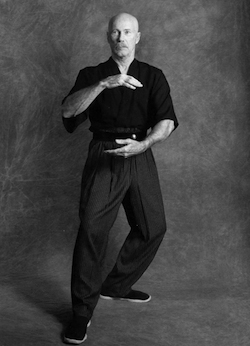
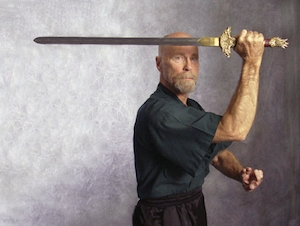
Ken Van Sickle, a native of New York City, is best known for his work in recording images of film and video of Cheng Man Ching, who he was a student of from some years. However is sword skills are exceptional and he has produced an excellent DVD and is currently working on a book on the subject. We are working on an article series about Prof. Cheng Man Ching right now. This will include an in depths video interview with Ken van Sickle as well. See the links below this article as well.
WHAT DID IMPRESS YOU MOST ABOUT MASTER CHENG MAN CHING?
Interview - Ken Van Sickle
First of all, he was the most relaxed human being I ever saw. At the same time his mind was always active, always doing something, he was at all times “right there”, never disconnected from present reality.
Although he is well known as the “Master of five excellences” (Medicine, Poetry, Calligraphy, Painting and Taijiquan) he was really an all-round personality whose abilities went well beyond the boundaries of those five arts.
He also was very open and friendly in his teaching. We know from people who studied with him in Taiwan that there he was rather aloof and dignified, as a traditional Taiji master was expected to be by that environment. When he settled in New York City he felt and enjoyed the completely different culture and changed accordingly. A notable example of this change is that Cheng Man Ching taught taiji fencing only in the United States, which raised some perplexities among his former students in Taiwan…..
IS THERE ANY “CORE TEACHING” FROM CHENG MAN CHING THAT YOU WOULD LIKE TO POINT OUT?
Not really a teaching , rather a way of teaching: Cheng Man Ching was really able to teach through body contact; it was not unusual for me to feel informations emerge from my body some time after practicing with him, although at the moment I had not understood what he was doing…. and at all times he really did what he said he was doing!
CHENG MAN CHING’S PUSH HANDS DEMONSTRATIONS ARE FAMOUS AND WELL DOCUMENTED. CAN YOU EXPLAIN WHAT DID IT FEEL LIKE BEING PUSHED BY PROFESSOR CHENG?
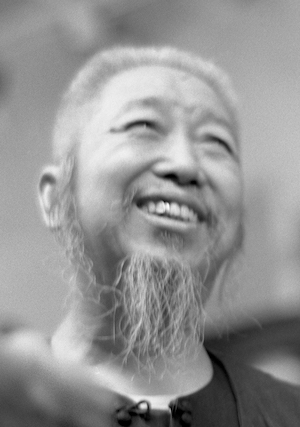
CHENG MAN CHING
You felt like being lifted by a big wave, you could not feel the pressure or push in any particular part of your body which was moved as a whole; it was very powerful but neither harmfull nor unpleasant. Actually Master Cheng never did Fa Jin (explosive manifestation of force), although he obviously could, because it can be very dangerous, especially if the force wave travels through internal organs. He rather did what is known as Ti Fang (“lift and let go”), or “uprooting”. Ti Fang requires sensitiveness and ability to tune in with your partner’s natural neuro-muscular reactions, and was done as follows:
First he lightly touched his partner and delivered a very slight pressure, which generated an instinctive wave of resistance. Precisely at that moment he released completely, yet without disconnecting, causing his partner to feel as if falling into emptiness and first sinking forward looking for support (which was not found since Cheng remained loose and relaxed) then unconsciously springing back from the front foot to regain balance. At that moment Professor Cheng sank into his partner accelerating him backwards into his back foot until the pressure made him pop up from the ground. Sometimes he sank very long into his partner maintaining his body loose and letting his own arms bend, then suddenly reconnected his structure, thus creating a particularly strong pressure. Only then his arms extended to follow the partner, he never used his arms to push.
YOU OFTEN REFER TO THE TAIJI SWORD AS THE “FEATHER SWORD”; WHERE DOES THIS EXPRESSION COME FROM?
It is something Professor Cheng used to say: he talked about handling a wooden sword or even a feather as if it were a razor-sharp steel blade until a steel sword felt like a feather in your hand……
AT WHAT LEVEL OF TAIJI PRACTICE WOULD YOU ADVICE BEGINNING FENCING?
Some good basic training in the solo form and push hands is essential, a student can enjoy fencing only when the attitude to relaxation and listening has developed. From this point of view any internal system of training, regardless of the name of the style, is a good base.
Remember that even experienced students will become very awkward at their first attempts to handle a sword, let alone practicing with a partner. In fact it takes quite a time before the sword really feels like a living extension of one’s body.
WHAT IS THE RELATION BETWEEN THE SOLO SWORD FORM PRACTICE AND THE FREE SYLE TAIJI FENCING?
The form helps to develop the correct dynamic connections between your center and the different parts of the sword (grip, center of balance, point) until the sword begins to feel like an extension of your body. Then, the sword form is a repository of fencing and combat techniques, almost everything we do in fencing is in the form. Cheng Man Ching did not explain much about the applications of the moves of the form, perhaps to some of his earlier students. What happens is that, after you have practiced the form and the free style fencing for a long time, the applications seem to manifest themselves very naturally.
ARE THOSE APPLICATIONS REALLY EFFECTIVE?
The Yang Style Sword form that we now practice is an evolution of an earlier form called Michuan, originally taught by Yang Luchan; Michuan was treated as an “inner family” tradition as opposed to the “public style” that was openly taught later by Yang Luchan himself and especially by Yang ChenFu.
Michuan was clearly combat-oriented and its movements and techniques were more straight, while the “public style” manifests more clearly the Taiji principles through circular and spiral movements. The fighting value of the “public style” form was questioned by some, as if were just a sweetened exercise for educated gentlemen and ladies; in reality the correct application of Taiji principles makes it as much combat effective as the earlier style.
DOES A REAL STEEL SWORD HELP IN THE FORM PRACTICE?
It certainly helps to refine the quality of your movement; the weight of a steel sword forces you to lead with your center and to find your best relaxed condition throughout the form. If you use too much contraction and arm force you will feel sore and exhausted after a few moves! Therefore I advise you to try it occasionally at the beginning, increasing frequency as you become familiar with it. Another helpful training tool is a tassel attached to the sword pommel: when the flow of you movements is correct it will dance, following your sword, but as soon as you do something wrong it will twine around your wrist and hand.
IN THE JAPANESE SWORDSMANSHIP SCHOOLS THEY OFTEN PRACTICE TEST- CUTTING OF BAMBOO SHAFTS OR TIGHTLY BOUND STRAW. DO YOU THINK IT CAN BE USEFUL FOR TAIJI FENCING STUDENTS?
Cutting a real target is a crucial test for the correctness of your technique, provided that you have long enough experience in the art, it is not certainly for beginners; you can practice with tree branches (please, not live trees!) or any other suitable material. If your alignment is not correct, if the grip is too loose or wrong-angled, if the whole move is not flawless you can hurt yourself. A good cut is clean, quick and, as it were, effortless.
If you don’t have a Chinese sword (Jian) adapted for real use, a good machete will do.
WHAT ARE THE MOST ESSENTIAL PRINCIPLES OF TAIJI FENCING?
Taiji fencing respects the principles of real fighting, therefore self-defense comes first: attacking is always subordinate to the protection of one’s body; practically speaking, the very first thing you have to learn is to have your blade between your body and your opponent’s blade most of the time.
The second principle is to maintain constantly a sensitive contact between your sword and the opponent’s and train to feel his force, energy and intention through this connection.
The third principle is to “get out of the way” when an attack comes straight towards you: never try to block an attack, that would be using force against force, and is opposite to the “yielding” principle; you should rather move your body just as much as needed to reach a safe distance, without overextending in any direction, and immediately reconnect with your opponent’s blade.
Circular movement is what supports those principles: always circle your blade around your opponent’s blade. It goes without saying that the circling of the sword is led by the movements of the center of your body. You also have to learn to move your body in a circle around your opponent, like Bagua Zhang walking.
HOW DO YOU TRAIN THE CIRCULAR MOVEMENT OF THE SWORD?
sword work
The main basic drill is called the “still-point” exercise, in which you move the sword in circles while keeping the point ideally still in front of you. First you move back and forth in half circles, then you learn to do full circles clockwise and counterclockwise. All movements are generated from your center which is connected to the center of the sword (that is its center of balance), while you let your arms and shoulders loosen.
In this way you also train another principle that is: try to keep the point of your sword directed to your opponent’s centerline and threatening him. From this principle it follows logically that you never try to attack while your opponent’s blade is threatening you because you would be immediately hit.
WHAT IS THE MAIN PURPOSE OF THE SWORD CIRCLING?
The purpose is to stick to your opponent’s blade and follow him listening to his force and intention (Ting jin, or “listening energy”); you never push or press on your partner’s blade, rather you look for any excess or deficiency on his part.
CAN YOU EXPLAIN WHAT YOU MEAN WITH “EXCESS OR DEFICIENCY”?
An example of excess is when your partner presses on your blade in any direction: this gives you the energy required for attacking; you move in the same circle and direction, then narrow the circling into a spiral that leads your blade to touch his body. This is an application of the Taiji principle of gathering the opponent’s force to your advantage. Feeling the changes in pressure through the sword is the basic level of Ting Jin for fencing.
An example of deficiency is an undue opening of the opponent’s guard, or even a slight fading of his attention: in this case you should immediately attack, it must be a split-second automatic reflex. You can train this while fencing with a partner by suddenly opening guard without any prearranged pattern; whenever one opens the guard the other must immediately attack.
WOULD YOU SAY SOMETHING ABOUT THE QUALITY OF “INTENTION” THAT SHOULD BE CULTIVATED IN TAIJI FENCING?
Cheng Man Ching, philosophy or other aspects of the arts
The quality is the same we look for in taiji push hands, so I will just mention some issues that are particularly relevant in the fencing context.
First of all “move sincerely”: commit yourself to the action you are performing, so that your partner receives something substantial rather than an external gesture, this influences deeply your instinctive body reactions and the forces involved. This also mean that you should never “feint” in the sense that any action must be supported by a real intention, otherwise the reaction that you expect from your partner will not take place.
Be ready to accept any opportunity that your partner offers you to cut him: it is a precious gift and it would be impolite to refuse it; you can show your gratefulness by cutting him softly, gently and with a smile. Taiji fencing requires a deep respect for your partner’s body, so you never hit hard; safety is essential for fully enjoying this practice. In forty years of fencing I saw one nicked tooth, a cut on the head and some bruises on wrists, which is a very acceptable injury record as compared to other martial styles and sports. One thing that can help you to become more accurate and safety-oriented is to handle your wooden sword as if it were a real steel sword, with the same respect and carefulness required by a live blade.
Finally, I must mention the first and worst “sword disease”, that is the desire to win; this can slow down your learning or even cut you off the flow of deeper information coming from your teacher and your own body.
WHAT SHOULD YOU LOOK AT WHILE FENCING?
At the beginning you need to concentrate your vision to prevent your mind from wandering, so you will look at the swords, or at your partner’s eyes, but later on you will develop an overall vision, which is much better because any particular concentration point can easily trap your mind there. The key word is “stay centered”: if your opponent attacks you and your mind goes to the point he is threatening, the rest of your body will remain unguarded and open to be cut.
HOW DO YOU USE YOUR UNARMED HAND IN FENCING?
The left hand is essential, as in any other Taiji form of training all parts of the body must be fully connected to the center. First of all this hand constantly counterbalances the sword hand. Besides, it can be used, if the opportunity arises, to take control of your partner’s sword hand and simultaneously attack him with your blade. For this reasons you should never let it hang down limp, it must be a live hand: it is best kept ready for action in front of your body, the arm maintaining a round shape, carefully preventing your elbow to stick to your chest; pointing your index and middle finger to your sword hand wrist can help to get the correct posture.
WHAT IS YOUR OPINION ABOUT TAIJI FENCING TOURNAMENTS?
I am not particularly in favor of the way push hands and fencing tournaments are conducted, the overall level is not good enough and the rules keep changing, so most people end up into using brute force rather than taiji principles. Protective gear can even worsen this, although good for the physical safety of fencers. Cheng Man Ching was always playful and smiling while fencing, and we should try to keep this spirit alive.
Original article and pictures take taiji-forum.com site