When searching for Tai Chi benefits online, you will find a massive amount of information. There are webpages full of lists, research news and individual narration. It’s overwhelming.
So I came up with the idea to bundle all that information right here. And of course for each point I will give one or more sources to continue reading! Let’s start with
General Tai Chi Benefits
Increased strength both in the lower and upper extremities and also in the core muscles of the back and abdomen (source; source)
More flexibility (upper- and lower-body flexibility) (source)
Other research points to a drop in cholesterol levels (source)
Beneficial effects on bone health (source; source)
Reduction in stress (source) People who practise Tai Chi recognize its powerful effect on relaxation and concentration. It is tool to help you cope with the busy, modern-day life (source)
Higher self-efficacy (the confidence in and perceived ability to perform a behavior) (source)
Psychological benefits, such as reducing anxiety, depression and overall better mood, in both healthy people and those with chronic conditions. (source; source; source)
Beneficial for cognition functions, such as global cognitive ability, attention, learning, memory, language, etc. (source)
Improved ability to concentrate and multitask during cognitive tests. (source)
“One becomes more centred, more at peace with oneself and less subject to outside influences” (source)
Reduced mortality (among men in Shanghai) (source)
This form of exercise could be the perfect activity for the rest of your life (source)
It’s fun! (and thus you might be more likely to stick to it) (source)
Wow, if you don’t start training Tai Chi Chuan (or Qi Gong) right away, I don’t know what’s keeping you from it!
To reap all those Tai Chi benefits is really easy. One of the greatest advantage of Tai Chi is that anyone (regardless of age or level of fitness) can do it anywhere anytime. The risk of injury is very low. You don’t need equipment or a lot of space. Just find a teacher and start!
I personally like that it is non-competitive: You can learn at your own pace. However, it can be done in groups, which I enjoy a lot.
And there are lots of movements to keep you interested, and as you become more accomplished you can add those to your routine – it just nether gets boring!
But what if you have health issues and wonder if Tai Chi could help you to improve your quality of life? As you may know, some call Tai Chi “medication in motion”. Just have a look at all the Tai Chi benefits for specific health conditions and you sure know where that phrase comes from!
Tai Chi Benefits for Specific Health Conditions
Practicing tai chi may help to improve balance and stability in those with Parkinson’s disease (source; source)
Arthritis: positive benefits within a month or two of practicing (source)
Adding Tai Chi to your life could help lower your risk for developing dementia or Alzheimer’s disease (source; source)
It may reduce pain from knee osteoarthritis and improve health-related quality of life (source; source)
For postmenopausal women with osteopenia (low bone mineral density), practicing tai chi may improve quality of life (source)
Tai chi exercise may improve quality of life, mood, and exercise self-efficacy (belief in one’s own abilities) in people with chronic heart failure (source). In addition, it may enhance sleep stability in those patients. This sleep effect may have a beneficial impact on blood pressure, arrhythmogenesis and quality of life (source; source; source)
Improved quality of life in people with heart disease, cancer (source), mesothelioma (here), and other chronic illnesses (source)
Beneficial for women with breast cancer due to improved arm functional mobility, muscle strength, and physical capacity (source; source)
Improved blood glucose levels and improved control of type 2 diabetes and immune system response (source)
Eased fibromyalgia pain and better general quality of life (source). Helps people with fibromyalgia sleep better and cope with musculoskeletal pain, fatigue, and depression. (source; source; source)
Valuable complementary treatment for vestibular disorders (source; source; source)
In China, it is believed that Tai chi can aid in the treatment digestive disorders and skin diseases (source)
Again, that is an impressive list, don’t you think?
But most of scientific research is conducted with seniors. This area of research is important because fall-related injuries are the leading cause of death from injury and disability among older adults.
Obviously all the Tai Chi benefits noted above are also valid for Seniors. However, there are certain aspects that are particularly beneficial for Seniors:
Benefits of Tai Chi for Seniors
A growing body of research is building a compelling case for Tai Chi as an adjunct to standard medical treatment for the prevention and rehabilitation of many conditions commonly associated with age (source; source)
Improvements in physical functioning, bodily pain, vitality and mental health. (source)
Improved balance, muscle strength and flexibility, which makes it easier to recover from a stumble. Fear of falling can make you more likely to fall; some studies have found that Tai Chi training helps reduce that fear (source). It could be even more beneficial to combine Tai Chi with music (source)
Practicing Tai Chi may help to improve balance and stability in older people and reduce the number of falls and associated injuries (source ;source; source; source)
Better proprioception (ability to sense the position of one’s body in space), which declines with age. Tai chi helps train this sense, which is a function of sensory neurons in the inner ear and stretch receptors in the muscles and ligaments (source)
Reduced stress, improved balance and general mobility, and increase muscle strength in the legs (source)
Tai chi also may improve reasoning ability in older people (source)
Improved sleep quality in older adults with moderate sleep complaints, and may help to prevent the onset of insomnia (source)
May help older adults avoid getting shingles by increasing immunity to varicella-zoster virus and boosting the immune response to varicella vaccine (source)
Seniors with depression benefit from Tai Chi (source)
“The brains of older people who had been practicing tai chi for several years were compared with the brains of age-matched sedentary adults. The tai chi participants showed greater connectivity and other measures of health in portions of the brain known to be involved in decision-making and attention than the volunteers who had never done tai chi.” (source)
I really hope that his long long list of Tai Chi benefits helps you to go to that class and get into practicing Tai Chi! Even if you are perfectly healthy, it is just so much fun and the best thing really is: you can do this for the rest of your life!
Just in case: if you practice Taijiquan already and want to practice more have look at my “Practice like a Master: Daily” eCourse! It is full of tricks and tools and will help you to get into the habit of practicing more. So you can reap all the health benefits!
Happy Qi!
Angelika
P.S.: I know there are some people who do not believe in studies or who think those studies are not conducted well enough. Well, in that case I just recommend to do a personal case study: try Tai Chi yourself for 12 weeks, practice twice a week or even daily and see what happens!
And finally I would just like to add: though Tai Chi has that many benefits and is quite safe to practice, if you have a health condition or are pregnant, it is a good idea to talk to your health care providers before beginning any exercise program!
Original article and pictures take qialance.com site
The most extensive list of Tai Chi & Qi Gong blogs in the world
Qi Blogs are what I call all the different Taijiquan and Qi Gong blogs. And there are so many of them!
Some post regularly, some haven’t posted for a while, some write not only about Taijiquan (or Tai Chi) and Qi Gong. They also talk about meditation, health, Traditional Chinese Medicine, or other martial arts. I really recommend to visit these blogs, click through them and find your favorite ones.
There are quite a lot of bloggers that do not blog very regularly. Or they even stopped blogging at all. That’s why I wrote about my favorite active blogs here: 15 Top Tai Chi Blogs!
And by the way, Bloglovin is a really nice tool which makes it easy to stay up to date with Qialance and many other Tai Chi and Qi Gong blogs!
The meaning of Grasp the Bird’s Tail (揽雀尾 Lǎn Qùe Wěi) explained
One of the most important movements in Taijiquan is to Grasp the Bird’s Tail. Actually it is a series of very basic moves: Peng, Lü, Ji and An.
It is not only called Grasp the Bird’s Tail, some call it “Grasp the Sparrow’s Tail” and the Chinese name is Lǎn Qùe Wěi (揽雀尾 or simplified 拦雀尾).
Grasp the Bird’s Tail is a movement you will learn quite early in many forms, e.g. the 24 form or Yang long form (108). These moves are just so important that there are shorter Taijiquan forms which basically consist of only Grasping the Bird’s Tail!
That is why I wanted to find out what that name means. I do not speak Chinese, but on my quest for an answer I found this really interesting book:
The author Jane Schorre practices Taijiquan for more than 30 years. She is also not a Chinese native speaker, but she started to get interested in the names of the Taijiquan movements.
Talking to a Chinese friend, she found out about all the different aspects that are within the Chinese names and characters. To improve her understanding of Taijiquan, she wanted to get even deeper into it.
So she started researching all kinds of meanings and stories. However, she wanted to stay playfully and not become too academic in her explanations. I think that makes the book really a pleasurable read.
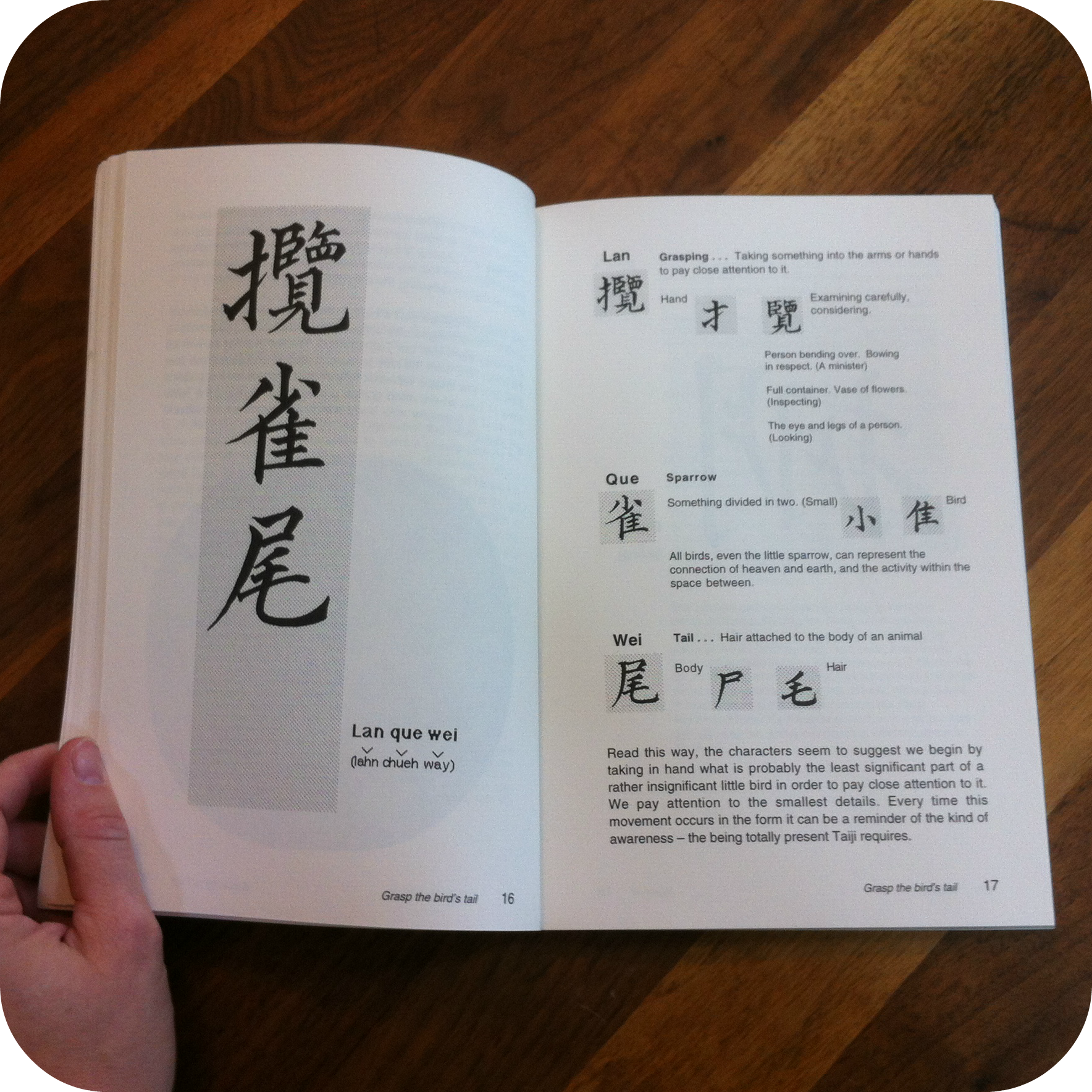
In the book you will find a calligraphy on the left and an explanation of all the Chinese characters on the right. Sometimes Jane Schorre added some complementary notes and thoughts. This for example is the page of “Grasp the Bird’s Tail”:
So now let’s get deeper into these Chinese characters:
Lǎn 揽 (or simplified 拦) means grasping. It actually consists of two characters: one for “hand” and one for “examining carefully”
Qùe 雀 is a sparrow. It also consists of two characters: “small” and “bird”
Wěi 尾 means tail. The character can be divided in “body” and “hair”
So the short direct translation of Lan Que Wei (揽雀尾) could be “Grasp Bird Tail”. But you could also say “Hand examine carefully small bird’s body hair”!
As I said, Jane Schorre adds comments to most of the moves and Chinese characters. And I think that is really valuable. They are often ideas for practicing Taijiquan. So she writes about Grasp the Bird’s Tail:
“Read this way, the characters seem to suggest we begin by taking in hand what is probably the least significant part of a rather insignificant little bird in order to pay close attention to it. We pay attention to the smallest details. Every time this movement occurs in the form it can be a reminder of the kind of awareness – the being totally present Taiji requires.”(page 17)
Wow! I have to admit that I am some kind of detail freak in the Taijiquan form. So I find it magnificent that there is what I would call a “mind the details-reminder” implemented in the form!
And of course I think this would be a good time for you to get up and practice this: mind the details in Peng, Lü, Ji, An: Grasp the Bird’s Tail!
Happy Qi!
Angelika
P.S.: Unfortunately How to Grasp the Bird’s Tail if You Don’t Speak Chinese is out of print. If you ever find it somewhere I highly recommend you buy it! The book is truly inspiring no matter which Taijiquan style you practice.
Original article and pictures take qialance.com site
Tai chi, or "moving meditation," is a slow, graceful, and relaxed series of movements that combines aerobics, flexibility, balance, and weight-bearing exercise with deep breathing and meditation. Tai chi dates back to 12th century China and it is believed that the Taoist monk Chang San-Feng developed the practice as a martial art form. It is said that the movements were derived from observing a snake and a crane in battle. Chang San-Feng believed that these creatures were the ones most able to overcome a stronger opponent.
Tai chi has grown in popularity in the United States as a safe, low-impact exercise that can be practiced alone or in a group. Many practitioners of tai chi believe that it improves their fitness level, physical health, and emotional well-being.
A review, published in the Archives of Internal Medicine, that looked at 47 studies on the effects of tai chi, concluded that this ancient Chinese discipline has physical and psychological benefits. The authors stated that tai chi is safe and effective in promoting balance, flexibility, and cardiovascular health, and is particularly valuable for older people with chronic health conditions.
The Flow of Life Energy
Tai chi is based on the theory that your mind, body, and spirit must be in balance. Chinese philosophy holds that all of us and everything in the universe contain elements of "yin and yang." Yin has the qualities of water — stillness, coolness, and femininity. Yang has the qualities of fire — brightness, activity, and masculinity. To maintain health, these inner forces must remain balanced so that your life energy, called qi (pronounced "chee"), can flow freely in your body.
How Tai Chi Can Help You
Researchers who have studied tai chi have reported benefits for patients who have heart disease, respiratory problems, high blood pressure, arthritis, and multiple sclerosis. Older people may improve their balance, strength, and flexibility and lessen their chance of falling. Studies also found that tai chi can decrease pain, stress, and anxiety in healthy patients.
The three main elements of tai chi are movement, breathing, and meditation. Here’s how these practices can benefit health:
Fitness and flexibility. Because tai chi is a weight-bearing form of exercise and will use all your major muscle groups, it improves strength and endurance. Its movements also enhance balance, agility, coordination, and flexibility.
Heart and respiratory health. Tai chi is an aerobic form of exercise, which means your heart works harder and increases the flow of oxygen in your blood. Aerobic exercise has been shown to benefit your heart and may lower your cholesterol. Tai chi breathing exercises increase your lung capacity and improve circulation of oxygen.
Mental health. Research shows that meditative aspects of tai chi can help relieve stress, improve concentration, and lower blood pressure and reduce your heart rate.
Overall well-being. Tai chi may improve your digestion and your immune system, and help you sleep better. People who practice tai chi regularly often report an overall feeling of improved wellness. Results of two randomized controlled trials found that older adults who participated in a 16-week or 6-month tai chi program reported greater psychological well-being, life satisfaction, and perceptions about their health than a control group not participating in tai chi.
If you want to learn tai chi, taking a class is a good option. Talk to your doctor first if you have any significant health problems. Tai chi is very safe and can be adapted to most any health issue, so discuss any condition with your teacher before you begin. One note of caution is that the practice of tai chi is not regulated in the United States, so be sure to ask about your teacher's experience and qualifications.
To find a tai chi class in your area, try your local YMCA, senior center, or fitness center. The American Tai Chi Association has a Web site that can help you locate classes.
If you are looking for an exercise class that combines an effective workout with the emotional benefits of meditation, tai chi may be the perfect option for you.
Original article and pictures take images.agoramedia.com site
I am happy to release The Insider’s Guide to Tai Chi. It contains 100-pages of information about tai chi and you can download it here. We are going to be releasing the Tai Chi Mastery Program in a few days so stay tuned.
When it comes to exercise and fitness, you have countless choices: weight lifting, running, yoga, Pilates, biking, tennis, golf, cross-fit and other “fad” programs that come and go. With so many choices, it can be difficult to determine what is right for you.
So why learn tai chi and why take the time to really learn it right?
I believe tai chi is the future of fitness and exercise. Tai Chi Chuan translated into the English language literally means “the supreme ultimate.” Tai chi is what I call an Uber-exercise because you can do it for health, healing, martial arts and meditation.
Tai chi can totally transform your life so you feel better and more connected to your body, mind and spirit. Tai chi is one of the best practices for long-term health and longevity. Tai chi is known for helping to heal and even reverse various injuries with virtually no downsides. Tai chi releases chronic stress and builds your qi or energy.
Practicing tai chi literally rewires your body’s nervous system. Many find that once they learn tai chi they don’t have to force themselves to do exercise every day. Instead, they want to do tai chi every day because it makes them feel relaxed, integrated and whole. Many join tai chi practice groups and form lasting friends and community.
Another piece of good news is more research studies are being published that confirm what Eastern practitioners have known for thousands of years – you can prevent illness and also contribute to your own healing through applied practice of tai chi. This ongoing tai chi research offers scientific proof of its benefits and will help fuel its popularity.
Although tai chi is finally gaining mass popularity, in the West many of Tai Chi’s original teachings are unfortunately becoming more diluted and watered down. Even when I learned tai chi in Beijing, China, almost 30 years ago, it was becoming apparent that the overall skill level of tai chi practitioners was declining because few did it solely as their primary profession.
If you are considering learning tai chi or if you already practice tai chi, one important thing to learn and know about tai chi is what really gives it the power. This is the internal energetics or neigong that you put inside your tai chi form. This has been my focus where I teach these neigong both in qigong sets and within tai chi.
If you want your tai chi to really do what it can do, you have to go beyond just learning the physical movements. Learning how to use the mind to affect what is happening in the body is a key. Few in the West know how to teach these original energetic components. Fewer know the correct linking procedure so that the possibilities of tai chi can become a reality in your body.
In China it is widely accepted that you need about ten years to become a competent tai chi instructor. Those with previous experience in other internal arts might be able to do it in five years, but that is the exception. Part of the reason this is so is because a person has to fully embody the energetic components in his or her body. Just as an oak tree cannot grow in a day, tai chi teachers take time to mature and develop. They must rebuild and upgrade their energetic system.
As there are different forms being created and more teachers appearing on the scene, I encourage you to learn an authentic form and to study with the best qualified teacher you can find. This means a teacher that been properly trained and can fully embody the principles of tai chi.
I have created The Insider’s Guide to Tai Chi to provide you with foundational information to help you understand and evaluate the expanding body of material available about tai chi in the West. I’ll also go deeper to explain neigong, which is the secret that powers tai chi. Neigong translated means ‘internal energy work’ and it explains how qi flows in the body. It is what makes tai chi effective as a martial art, as a health exercise and even for meditation.
When I started learning tai chi many years ago, I found and worked with some of the best masters in China within the Chen, Yang and Wu tai chi lineages. I believe that it is my responsibility to share what they taught me with as many people as possible. This tai chi report, my blog at www.taichimaster.com, the Tai Chi Mastery Program and my live events are ways I can share what I learned with you.
I have been practicing and teaching tai chi now for more than 45 years and counting. I first wanted to learn tai chi for my martial arts and had little interest in its health benefits. At the time I was a young man that loved both doing and teaching martial arts. What I found in the internal marital art of tai chi was a system for being strong into old age without the joint and body damage associated with external martial arts.
Later, as time went on, I used tai chi to heal my own body from other illnesses. Once, in India, I contracted a deadly case of hepatitis. Tai chi literally saved my life when I used it to open up the blocked energy channels in my body. The two other people on either side of me in the hospital that had the same thing died. I have had the unfortunate luck to be in eight major car accidents – one in 1982 that broke multiple vertebrae in my back, which doctors said would likely leave me paralyzed. I initially used the Yang Style to heal my upper back and then used the Wu Style of tai chi to heal my lower back. Without tai chi I don’t think I would be walking today.
I’m now over 60 years of age and I continue to use my tai chi practice to further heal my body. Not everyone will find the results I have, solely because very few people will dedicate themselves so completely to tai chi. But you’ll find you get out of it what you put in, and everyone, regardless of age or physical fitness, can achieve life-changing benefits through dedicated, applied practice.
In The Insider’s Guide to Tai Chi I hope to provide you a practical understanding of what tai chi is, what makes it work so well, and how to choose a style, teacher and practice regimen. I created this report and have given it away because I believe that it contains essential information that will be useful on your tai chi journey, whether you end up studying with me or another teacher.
I hope you learn, practice and eventually teach this amazing art that can continually transform your life!
This gentle form of exercise can help maintain strength, flexibility, and balance, and could be the perfect activity for the rest of your life.
Tai chi is often described as "meditation in motion," but it might well be called "medication in motion." There is growing evidence that this mind-body practice, which originated in China as a martial art, has value in treating or preventing many health problems. And you can get started even if you aren't in top shape or the best of health.
In this low-impact, slow-motion exercise, you go without pausing through a series of motions named for animal actions — for example, "white crane spreads its wings" — or martial arts moves, such as "box both ears." As you move, you breathe deeply and naturally, focusing your attention — as in some kinds of meditation — on your bodily sensations. Tai chi differs from other types of exercise in several respects. The movements are usually circular and never forced, the muscles are relaxed rather than tensed, the joints are not fully extended or bent, and connective tissues are not stretched. Tai chi can be easily adapted for anyone, from the most fit to people confined to wheelchairs or recovering from surgery.
Tai chi movement
A tai chi class practices a short form at the Tree of Life Tai Chi Center in Watertown, Mass.
"A growing body of carefully conducted research is building a compelling case for tai chi as an adjunct to standard medical treatment for the prevention and rehabilitation of many conditions commonly associated with age," says Peter M. Wayne, assistant professor of medicine at Harvard Medical School and director of the Tai Chi and Mind-Body Research Program at Harvard Medical School's Osher Research Center. An adjunct therapy is one that's used together with primary medical treatments, either to address a disease itself or its primary symptoms, or, more generally, to improve a patient's functioning and quality of life.
Belief systems
You don't need to subscribe to or learn much about tai chi's roots in Chinese philosophy to enjoy its health benefits, but these concepts can help make sense of its approach:
Qi — an energy force thought to flow through the body; tai chi is said to unblock and encourage the proper flow of qi.
Yin and yang — opposing elements thought to make up the universe that need to be kept in harmony. Tai chi is said to promote this balance.
Tai chi in motion
A tai chi class might include these parts:
Warm-up. Easy motions, such as shoulder circles, turning the head from side to side, or rocking back and forth, help you to loosen your muscles and joints and focus on your breath and body.
Instruction and practice of tai chi forms. Short forms — forms are sets of movements — may include a dozen or fewer movements; long forms may include hundreds. Different styles require smaller or larger movements. A short form with smaller, slower movements is usually recommended at the beginning, especially if you're older or not in good condition.
Qigong (or chi kung). Translated as "breath work" or "energy work," this consists of a few minutes of gentle breathing sometimes combined with movement. The idea is to help relax the mind and mobilize the body's energy. Qigong may be practiced standing, sitting, or lying down.
Getting started
The benefits of tai chi are generally greatest if you begin before you develop a chronic illness or functional limitations. Tai chi is very safe, and no fancy equipment is needed, so it's easy to get started. Here's some advice for doing so:
Don't be intimidated by the language. Names like Yang, Wu, and Cheng are given to various branches of tai chi, in honor of people who devised the sets of movements called forms. Certain programs emphasize the martial arts aspect of tai chi rather than its potential for healing and stress reduction. In some forms, you learn long sequences of movements, while others involve shorter series and more focus on breathing and meditation. The name is less important than finding an approach that matches your interests and needs.
Check with your doctor . If you have a limiting musculoskeletal problem or medical condition — or if you take medications that can make you dizzy or lightheaded — check with your doctor before starting tai chi. Given its excellent safety record, chances are that you'll be encouraged to try it.
Consider observing and taking a class. Taking a class may be the best way to learn tai chi. Seeing a teacher in action, getting feedback, and experiencing the camaraderie of a group are all pluses. Most teachers will let you observe the class first to see if you feel comfortable with the approach and atmosphere. Instruction can be individualized. Ask about classes at your local Y, senior center, or community education center. The Arthritis Foundation (www.arthritis.org; 800-283-7800, toll-free) can tell you whether its tai chi program, a 12-movement, easy-to-learn sequence, is offered in your area.
If you'd rather learn at home, you can buy or rent videos geared to your interests and fitness needs (see "Selected resources"). Although there are some excellent tai chi books, it can be difficult to appreciate the flow of movements from still photos or illustrations.
Talk to the instructor. There's no standard training or licensing for tai chi instructors, so you'll need to rely on recommendations from friends or clinicians and, of course, your own judgment. Look for an experienced teacher who will accommodate individual health concerns or levels of coordination and fitness.
Dress comfortably. Choose loose-fitting clothes that don't restrict your range of motion. You can practice barefoot or in lightweight, comfortable, and flexible shoes. Tai chi shoes are available, but ones you find in your closet will probably work fine. You'll need shoes that won't slip and can provide enough support to help you balance, but have soles thin enough to allow you to feel the ground. Running shoes, designed to propel you forward, are usually unsuitable.
Gauge your progress. Most beginning programs and tai chi interventions tested in medical research last at least 12 weeks, with instruction once or twice a week and practice at home. By the end of that time, you should know whether you enjoy tai chi, and you may already notice positive physical and psychological changes.
No pain, big gains
Although tai chi is slow and gentle and doesn't leave you breathless, it addresses the key components of fitness — muscle strength, flexibility, balance, and, to a lesser degree, aerobic conditioning. Here's some of the evidence:
Muscle strength. Tai chi can improve both lower-body strength and upper-body strength. When practiced regularly, tai chi can be comparable to resistance training and brisk walking.
"Although you aren't working with weights or resistance bands, the unsupported arm exercise involved in tai chi strengthens your upper body," says internist Dr. Gloria Yeh, an assistant professor at Harvard Medical School. "Tai chi strengthens both the lower and upper extremities and also the core muscles of the back and abdomen."
Flexibility. Tai chi can boost upper- and lower-body flexibility as well as strength.
Balance. Tai chi improves balance and, according to some studies, reduces falls. Proprioception — the ability to sense the position of one's body in space — declines with age. Tai chi helps train this sense, which is a function of sensory neurons in the inner ear and stretch receptors in the muscles and ligaments. Tai chi also improves muscle strength and flexibility, which makes it easier to recover from a stumble. Fear of falling can make you more likely to fall; some studies have found that tai chi training helps reduce that fear.
Aerobic conditioning. Depending on the speed and size of the movements, tai chi can provide some aerobic benefits. If your clinician advises a more intense cardio workout with a higher heart rate than tai chi can offer, you may need something more aerobic as well.