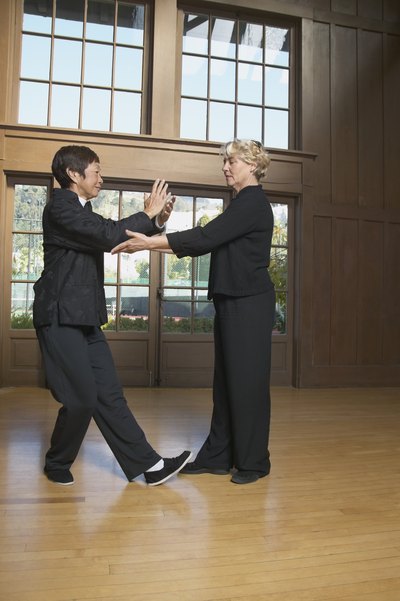
In this video, Jet Li introduces the Online Academy, a systematic and revolutionary approach to learning Tai Chi for beginners, as well as mindfulness and meditation techniques to help you relax your mind and bring more balance into your life.
This program is perfect for teaching Tai Chi for beginners with it's principles based step by step approach. You will learn all the fundamental principles of Tai Chi. It is also a very valuable resource for more advanced students who want a better grasp of the concepts and principles in Tai Chi.
With the Taiji Zen Online Academy, you will learn the complete art of Tai Chi Chuan. Whether you are a beginner or a more advanced Tai Chi student, you will benefit from this program. The videos teach you the core principles of Tai Chi Chuan and the training manuals provide much information on background, theory and in-depth explanations of the movements. Each level (duan or 段) introduces incrementally more complex concepts, principles and partner practices.
Original article and pictures take s.ytimg.com site
In this Tai Chi for beginners video, Tai Chi Master Bruce Frantzis explains how to lengthen the spine in commencement. This tai chi video is part of Bruce's Tai Chi for Beginners program which teaches a mini Wu style Tai Chi form.
Learn the terminology for the movements associated with tai chi.
You will also learn the proper way to do these movements and the why behind them.
“Energy Arts is dedicated to offering the most comprehensive tai chi, qigong (chi gung), internal martial arts, breathing and meditation programs on the planet."
This large wall chart outlines the Tai Chi for Arthritis movements with photos and descriptions. It is a useful resource for individuals or for instructors to place in a prominent position for students' easy reference.
Dimensions: 23in x 33in (841mm x 594mm)
Original article and pictures take cdn2.bigcommerce.com site
Several tai chi exercises can be done in a chair. It’s important to sit in the proper position for your exercises and to use a chair without arms. Sit forward and keep your back straight. Keep your legs at a 90-degree angle to the ground. You might have your knees slightly lower than your hips. This encourages your back to stay straight.
Gather Chi from the Side
Hold your palms in front of you at the level of your lower abdomen. This is called Dan Tien. Breathe steadily in as you open your arms out at waist level, similar to a pair of swing doors. Your palms can turn down or outward as you open. Try to open to about 90 degrees to the front, but stop opening if you become uncomfortable. Turn your palms so they face forward. Breathe out steadily as you bring them back in. Pause with your hands. Let your mind dwell here, advises the Beat Chronic Fatigue Syndrome website, before repeating. Do eight to 40 repetitions.
Touch the Sky With Your Palms
Put both hands in your lap with palms facing up. Inhale and slowly let your hands float up to chest level. Gradually turn your palms out. Turn them to face the sky. Stretch until you are fully extended. However, do not strain and keep your elbows bent slightly. Exhale and relax your arms out and down to your sides. Go back to the beginning position. Do this five to 10 times, advises Domingo Colon in his book, “Senior’s Tai Chi Workout: Improve Balance, Strength and Flexibility.”
Move Chi Up and Down
Start with your palms at Dan Tien. Have your middle fingers one to two inches apart. Breathe in as you turn your palms up and lift your hands in a line straight up the front of your body. When your arms and elbows are level, turn your palms down. Exhale and bring your hands back down in a straight line, ending in Dan Tien Rotate your wrists so your palms face up again. Repeat, doing eight to 40 of these sequential movements, advises the Beat CFS website.
Begin with your hands at Dan Tien. Turn your palms up. Bring them up the front of your body to your neck. Have palms facing your throat and tuck your right thumb into the right palm. Close your other fingers to form a loose fist. Meanwhile, turn your head to look 90 degrees to the left. Also extend your left hand at shoulder height. Keep your fingers up and your palm pushing out toward the left. Do not let the left arm lock or get tense. Your posture will resemble an archer’s. Turn both of your palms to face forward and turn your head to face front. Extend your right arm to the side. Breathe in and bring your arms in toward the center, keeping them at shoulder. This draws chi in to area of the center of the throat. Repeat this exercise on the other side. Do as many repetitions as it is comfortable to do. Make sure you do an even number on each side. Bring your hands down from the throat to Dan Tien when you finish your set of repetitions, advises the Beat CFS Website.
Original article and pictures take www.livestrong.com site
I f you have rheumatoid arthritis symptoms, tai chi exercises are a great way to stay physically active while improving mobility and balance. Find out why tai chi is so beneficial and try movements specially selected for people with RA...
During a flare-up of rheumatoid arthritis symptoms, pain and fatigue make exercise the last thing you want to do.
But one workout – a traditional Chinese practice called tai chi – is gentle enough to do even with aching, swollen joints, says Daniel Arkfeld, MD, associate professor of clinical medicine and director of rheumatology education at the University of Southern California in Los Angeles.
Tai chi is a safe way to stretch and strengthen muscles and de-stress your mind, Dr. Arkfeld says. And the slow, gentle movements are so easy on the body that most rheumatoid arthritis patients can practice them, he notes.
“Patients are able to participate even with advanced cases of the disease,” he says.
Rheumatoid arthritis patients who did tai chi exercises for at least eight to 10 weeks felt significant improvement in their range of motion, especially in the hips, knees and ankle joints, according to a 2010 research analysis by the Cochrane Database of Systemic Reviews, a nonprofit British scientific organization. They also had a 35% lower risk of falls than those who didn’t do the exercises.
Tai chi also improved mood and reduced depression, the studies found.
Tai chi is a complete mind and body martial art that increases stamina, strength, balance and concentration skills.
Tai chi exercise is a gentle way for anyone to engage not only her body, but additionally her mind. Unlike high-impact activities like running or high intensity aerobics, tai-chi will help energize practitioners in a relaxing and calming way.
Tai Chi Moves for Beginners
As a beginner, you need to first know its underlying philosophy, that’s, if one uses hardness to obstruct or block violent force, injuries to some degree are inevitable. Thus, at the start, students are not taught directly how you can fight an incoming force but to get it with softness and relaxed posture, while following a motion, while remaining in contact with that force. This has to be done till the force of attack is exhausted or that’s redirected.
Windmill Exercise
The windmill exercise is a of the basic Tai Chi movements for promoting flexibility and opening up your spine. Stand together with your feet parallel and slightly wider than shoulder-width distance apart. Relax your shoulders and let your arms hang loosely. Take the hands in front of your body from your pubic bone, with your fingers pointing down toward the ground. Inhale and raise your arms in the center of your body and over your head, fingers pointing up. Stretch toward the ceiling and arch your spine slightly backward. Exhale and slowly bend toward the floor, moving your hands on the center of your body. Bend forward out of your hip joint, allowing your arms to hold loosely in front of you. Inhale and go back to your starting posture.
Knee Rolls
Knee rolls encourage mobility inside your spine and knees and can help improve your balance. Stand together with your feet a few inches apart as well as your knees slightly bent. Place your hands on your knees with your fingers pointing toward one another. Rotate your knees in a circle, rolling in the left, back, right and front, as if you are tracing a large circle on the ground with your knees. Perform the circular motion in clockwise, then counter-clockwise, directions.
Hand Exercises
The Tai Chi hand exercises help open your hands and promote flexibility inside your shoulders, arms and fingers. Stand together with your feet a bit wider than shoulder-width distance apart. Lift up your arms straight out in front of you, parallel towards the floor at shoulder height. Stretch both hands as wide as you can, then begin rotating your wrists inside a clockwise and then counter-clockwise direction.
Closing Posture
Tai Chi Exercises
The Tai-chi closing posture is performed at the conclusion of a Tai Chi practice to balance your time and promote feelings of relaxation and stillness. Stand together with your feet hip-width distance apart. Relax shoulders and bring your hands in a cupped-position together with your palms facing up, resting in-front of your pelvis. Close your vision. Inhale and imagine that you are pulling your time upward as your bring your hands in the center of you body for your chest. Exhale and rotate both hands so your palms are facing down.
Benefits To Tai-chi Exercises
There are a number of benefits to tai chi exercise.
No equipment: This is a highly portable exercise program, as no special equipment is required. You can do tai chi just about anywhere; including inside or outdoors. For people who travel frequently, tai chi is an excellent way to practice a relaxing exercise program on the highway.
Improves coordination: As you perform tai-chi, your body flows through a series of movements, which look similar to a slow dance. You focus on breathing and slowly controlling your movements. This focus on maintaining the right posture and balance might help people become more physically aware and coordinated.
Good for anybody: People who suffer from arthritis or are extremely overweight often find it difficult to get familiar with exercise. They are not excluded, however, from tai-chi, as the movements can usually be achieved by anyone, regardless of the shape they’re in.
Original article and pictures take recreationxleisure.com site
Tai chi, an ancient Chinese martial art, combines systematic breathing with slow, specific movement to enhance balance, range of motion and relaxation. A 2010 review of studies published in American Journal of Health Promotion concluded that among its numerous benefits, the regular practice of tai chi improves bone density, provides heart protection, reduces falls in the elderly and bolsters immune function. The best way to learn tai chi is to work with a master in a class or through one-on-one sessions; DVDs are another way to visually understand this moving meditation. Precision and patience are required as you develop the moves.
Video of the Day
Tai chi intends to help the practitioner feel grounded, which helps promotes stability and balance. Many movements sink you toward the ground and focus on proper body alignment. One movement flows into the next, as you shift your weight from leg to leg. The names of moves are often inspired by animals and birds. Complex classes can contain dozens of movements, while simple, beginning classes focus on 13.
Meditation and deep breathing are intrinsic to the practice of tai chi. This encourages internal calming and peacefulness as well as the cleansing of stale air. In addition, these techniques help your muscles relax and release tension.
A full understanding of the principle of yin and yang is required for tai chi practice. Yin and yang simply means the practice of opposites. Yin refers to qualities of water, such as coolness or stillness, while yang is more aggressive and powerful, like fire. To be healthy, your yin and yang should be in balance -- and tai chi aims supports this. In tai chi, yin and yang practice shows up as stepping forward and then backward, or to the right and then the left. Tai chi postures also open and close or move up and down. Sometimes, depending on the class and the teacher's evaluation of the students' needs, a class may be more yin in nature, or more yang.
Most tai chi sessions begin with the opening stance, which has you stand with the feet hip distance and arms draped toward the floor, palms facing the thighs. Here, you settle into the breath and mindset needed to move on. The stance may seem simple, but requires observation of your posture and complete release of tension. After this, you move into positions such as "part the horse's mane," "white crane spreads it's wings," "play the lute," and "retreat and repulse monkey."
Tai Chi is based on eight precise movements called Bamen Wubu. "Bamen" means "eight doors" or "eight gates," and "Wubu" means "five steps." These movements are: ward off, roll back, squeeze and push, pluck and split, and elbow strike and bump. Because of the precision of each, work with an experienced practitioner to master each.
Tai chi variations and methods of practice can vary wildly. Some classes incorporate the principles of qigong, a slower and simpler practice of breathing and less-precise movement that also hails from China. You're encouraged to watch a class first, before joining, to see if the particular practice is right for you. For many people, it takes time to appreciate the quiet, measured pace of tai chi.
Original article and pictures take www.livestrong.com site